Between November and March the Canary Islands are the warmer, drier and more beach-friendly choice by a wide margin; Malta wins if you want a compact, history-packed short break where the weather is a pleasant bonus rather than the point. A typical January day in southern Tenerife reaches around 22°C, against about 15°C in Malta, and Malta's winter is surprisingly wet. In summer the tables turn: Malta is hotter, its sea is warmer and its rocky coves are at their best, while the Canaries stay in the high 20s.
The two are often weighed against each other by British travellers because both feel familiar. Malta was a British colony until 1964, drives on the left, uses the same three-pin plug as the UK and has English as an official language. The Canaries are Spanish through and through, but English is spoken throughout the resorts and the islands have been a British winter favourite for well over a century. Both use the euro, and both are in the Schengen area.
Where they differ is in what you do all day. Malta is a small, densely built archipelago of three inhabited islands, crowded with fortifications, churches and prehistoric temples, all within an hour or so of each other by bus. The Canaries are seven large volcanic islands with big resorts, long beaches, national parks and mountains. This page compares the weather month by month, the sea, the history, getting around and costs, and ends with a verdict for each kind of trip.
Winter warmth: not a close contest
Malta sits in the middle of the Mediterranean, at about 36°N, some eight degrees of latitude further north than Tenerife. Its winter is a true Mediterranean one: mild by British standards, but cool, cloudy at times and punctuated by rain-bearing storms. The Canaries sit off the coast of Africa in the path of the trade winds, with an ocean that barely cools, and their southern coasts are among the warmest places in Europe from November to March, as our page on the warmest island in winter shows.
In practice the difference is felt all day. A January afternoon in Valletta, at around 15°C, is lovely for walking the bastions in a light jacket, but most visitors will not want to sit by a pool. Evenings drop to about 9°C, and many older Maltese buildings, with their stone floors and high ceilings, feel cold inside in winter. In southern Tenerife or Gran Canaria, by contrast, the same evening is often warm enough to eat outdoors.
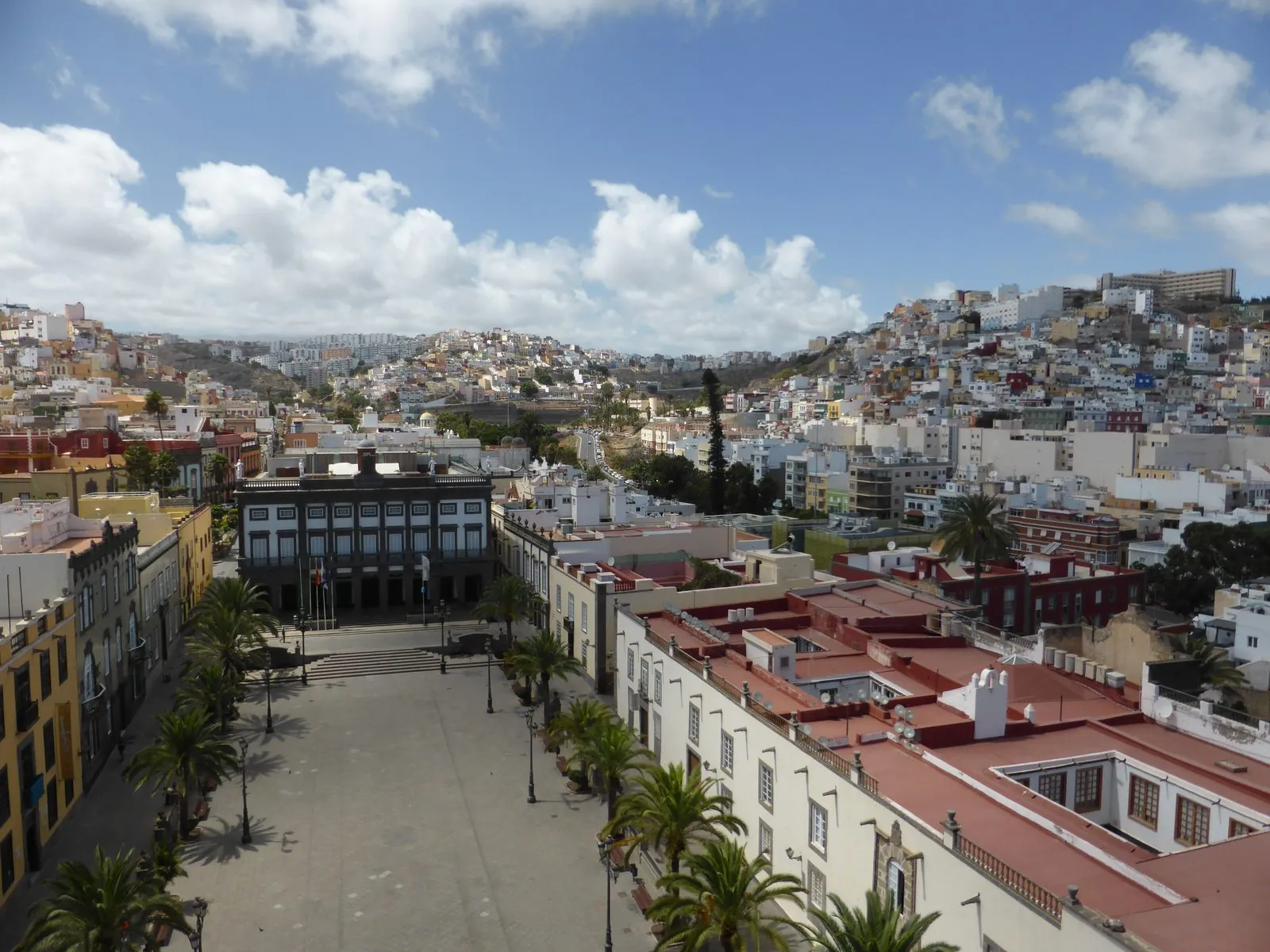
Photo: CARLOS TEIXIDOR CADENAS · CC BY-SA 4.0 · Wikimedia Commons · scaled
Month by month: Luqa against Tenerife South
The table compares the long-term averages for Luqa, Malta's airport, from the Malta Meteorological Office (the 1961–1990 normals published through the World Meteorological Organization), with the 1981–2010 normals for Tenerife South airport from AEMET, Spain's state weather agency. They are typical values, not forecasts. The Maltese normals come from an older thirty-year period than the Spanish ones, so treat the gap between the two columns as approximate rather than exact to the degree.
| Month | Tenerife South: day / night | Malta (Luqa): day / night | Rainfall: Tenerife South / Malta |
|---|---|---|---|
| January | 22°C / 15°C | 15°C / 9°C | 17 mm / 89 mm |
| March | 23°C / 16°C | 17°C / 10°C | 15 mm / 41 mm |
| May | 24°C / 17°C | 23°C / 15°C | 1 mm / 7 mm |
| July | 28°C / 20°C | 31°C / 21°C | 0 mm / 0 mm |
| September | 28°C / 21°C | 28°C / 20°C | 4 mm / 40 mm |
| October | 27°C / 20°C | 24°C / 17°C | 12 mm / 90 mm |
| December | 23°C / 17°C | 17°C / 11°C | 30 mm / 112 mm |
The rainfall column is the one most comparison pages leave out, and it is the surprise. On the long-term averages each national service publishes, Malta's December rainfall, about 112 mm, is more than twice London's December average of about 48 mm in the Met Office's 1981–2010 figures. It does not rain every day: Maltese rain tends to arrive in heavy autumn and winter downpours, often with thunder, between longer sunny spells. But October to January is plainly Malta's wet season, and a week of sunshine is far from guaranteed. Southern Tenerife gets about a quarter as much rain over the same months.
Summer, spring and the sea
From June to September Malta is hot and almost rainless, with average highs around 30–31°C in July and August and very warm nights. The Mediterranean around the islands is warm and, in calm weather, extraordinarily clear, and this is the season Malta is built for: boat trips, swimming off the rocks and long evenings on the waterfront. The Canaries are a few degrees cooler and breezier in midsummer, which suits families and walkers.
In winter the sea follows the air. The Mediterranean around Malta typically drops into the mid-teens Celsius by February and March, colder than the Atlantic around the Canaries, which stays around 18–19°C at its coolest, as our page on sea temperatures in the islands explains. A January swim is a bracing novelty in Malta and an ordinary part of the day for many visitors to the Canaries. Spring and autumn are the overlap: May and late September are pleasant in both, and Malta's September sea is the warmer of the two.
Beaches: rock ledges against sand
Malta's coast is mostly limestone, and the sandy beaches are few and well known: Mellieħa Bay (Għadira) and Golden Bay in the north-west of the main island, and Ramla Bay on Gozo. Much of the swimming happens from rock platforms, lidos and small inlets, often with ladders into deep, clear water. The Blue Lagoon on Comino is beautiful but very busy on summer days. It is a coast for swimmers and snorkellers rather than for building sandcastles.
The Canaries have far more beach and more kinds of it: the dunes at Maspalomas, the long golden strands around Corralejo, sheltered resort beaches in Tenerife and black volcanic sand elsewhere. Our page on the best family beaches picks out the calmest. The trade-off is that much of the Canaries' coast faces the open Atlantic, with waves, currents and red flags that Malta's sheltered bays rarely see in summer.
History on every corner
For history, Malta is in a different league. Valletta, built by the Knights of St John after the Great Siege of 1565, is a UNESCO World Heritage city small enough to cross on foot in twenty minutes. St John's Co-Cathedral holds Caravaggio's Beheading of St John the Baptist. The Grand Harbour, the Three Cities and the silent hilltop town of Mdina all sit within a short bus ride. Older still are the megalithic temples, such as Ġgantija on Gozo, which are among the oldest free-standing stone structures in the world, and the underground Ħal Saflieni Hypogeum, where visitor numbers are tightly limited and tickets need booking well ahead.
Twentieth-century history is close to the surface too. Malta endured heavy bombing in the Second World War and was awarded the George Cross in 1942, which still appears on the national flag. British visitors find the red post boxes and telephone boxes that survive from the colonial era oddly familiar.
The Canaries have their own story, from the Guanches, the islands' first inhabitants, to the Castilian conquest and the colonial towns of Las Palmas and La Laguna, told in our short history of the Canaries. But the islands' main draw is the landscape rather than monuments: Mount Teide, the lava fields of Timanfaya and the laurel forests of La Gomera.
Getting there and getting around
Malta is the shorter flight. From London a direct flight typically takes around three to three and a half hours, against four to four and a half to the main Canary islands, and there are frequent services from regional UK airports and Dublin. Malta is one hour ahead of the UK all year, while the Canaries keep UK time.
On the ground, Malta's buses reach almost everywhere on the two main islands, which makes a car-free holiday easy. Malta Public Transport's own fare page lists a single day-route ticket at €2.00 in the winter period from 18 October 2026 to 12 June 2027, and €2.50 in summer, valid for two hours, with seven-day Explore cards at around €25–27. Buses can be slow on Malta's congested roads, especially around Valletta at rush hour. Gozo is a short ferry ride from the north of Malta. In the Canaries, buses are good on the larger islands, as our page on Tenerife's TITSA buses shows, but many visitors hire a car to reach the mountains and quieter coasts, and you will be driving on the right.
One adapter fewer, one habit to relearn. In Malta, UK plugs fit the sockets and traffic keeps left, so British visitors who hire a car there feel at home. In the Canaries you need a European two-pin adapter, as our plug guide explains, and you drive on the right with roundabouts taken anticlockwise.
Paperwork, language and the small practicalities
Entry is the one area where the two are identical. Malta and Spain are both EU and Schengen members, so the same passport rules, the same 90-in-180-day limit and the same new European border checks apply to British visitors in both; our page on entry requirements for the Canaries sets them out, and they hold for Malta too. Health cover works the same way as well: a UK GHIC is valid in both, alongside travel insurance.
Language is where Malta has the edge for anyone nervous about being understood. English is an official language alongside Maltese, so menus, signs, bus timetables and conversations at the pharmacy are all in English. In the Canaries English is widely spoken in the resorts, but less so in the villages and the cities, and a few words of Spanish go a long way. Mobile roaming charges depend on your UK network's current European terms, which are the same for both destinations.
Costs on the ground
Both are euro destinations with large package and budget-airline markets, and neither is consistently cheaper over the year. Malta is at its cheapest in winter, which is the Canaries' high season, and at its most expensive in July and August. Tax makes a small difference: Malta charges standard EU VAT, at 18% on most goods and services, while the Canaries charge their own lower sales tax, IGIC, at 7% on most things, which shows up in drink and fuel prices. Our page on IGIC explains how it works.
For a longer winter stay, the comparison changes again. Malta's compact size means you can see most of it in a week, and many long-stay winter visitors find a month enough. The Canaries, with seven islands and much warmer winters, are the established choice for British travellers who spend several weeks or months escaping the northern winter.
Picking the right island for the trip
For winter sun, choose the Canaries. From November to March they are around six or seven degrees warmer by day, much warmer at night, far drier and better for beaches and swimming. Families, sun-seekers and long-stay winter visitors will be happier there, and our page on winter sun in the Canaries helps you pick the coast.
Choose Malta for a short break built around history, food and walking around old towns, at any time of year, or for a summer holiday of hot weather and clear Mediterranean coves. A winter long weekend in Valletta can be excellent, provided you pack a waterproof and treat any sunshine as a bonus. If you are comparing other Mediterranean islands with a British connection, our page on the Canaries and Cyprus covers the warmest of them.