The Presa Canario is a big, heavy guard and cattle dog bred in the Canary Islands, mainly on Gran Canaria and Tenerife, and it is the best known of several dog breeds the islands can call their own. The others are humbler and older: the Bardino or Perro Majorero, a rough-coated goat dog from Fuerteventura that helped create the Presa, and the Podenco Canario, a lean, prick-eared hound that still hunts rabbits in the hills. La Palma adds its own sheepdog.
For visitors, these dogs are part of the landscape rather than an attraction. You meet them guarding farms, working goats, travelling in the back of hunters' pick-ups on autumn Sundays, and cast in bronze outside a cathedral. Knowing which is which explains a surprising amount about how the islands lived before tourism.
The story of how the islands may have been named after dogs is told on our page about the Canary Islands flag and symbols, so this page starts where that one stops: with the breeds themselves, where they came from and where you are likely to see them.
Dogs before the conquest
Dogs were in the islands long before Castile arrived in the fifteenth century. The first islanders, whose way of life is described on our page about the Guanches, kept dogs alongside their goats and sheep, and those dogs were the foundation stock for much of what came later. They were working animals in a herding economy, not pets, and the qualities that mattered were stamina, a good nose and the ability to hold an animal still on steep, rocky ground.
After the conquest, settlers brought their own dogs from mainland Spain, Portugal and elsewhere, and island dogs were crossed with them over the centuries. What survives today as distinct breeds is the result of that mixing, filtered by isolation and by the work each island needed done: goats on dry Fuerteventura, cattle and guarding on Gran Canaria and Tenerife, rabbits everywhere.
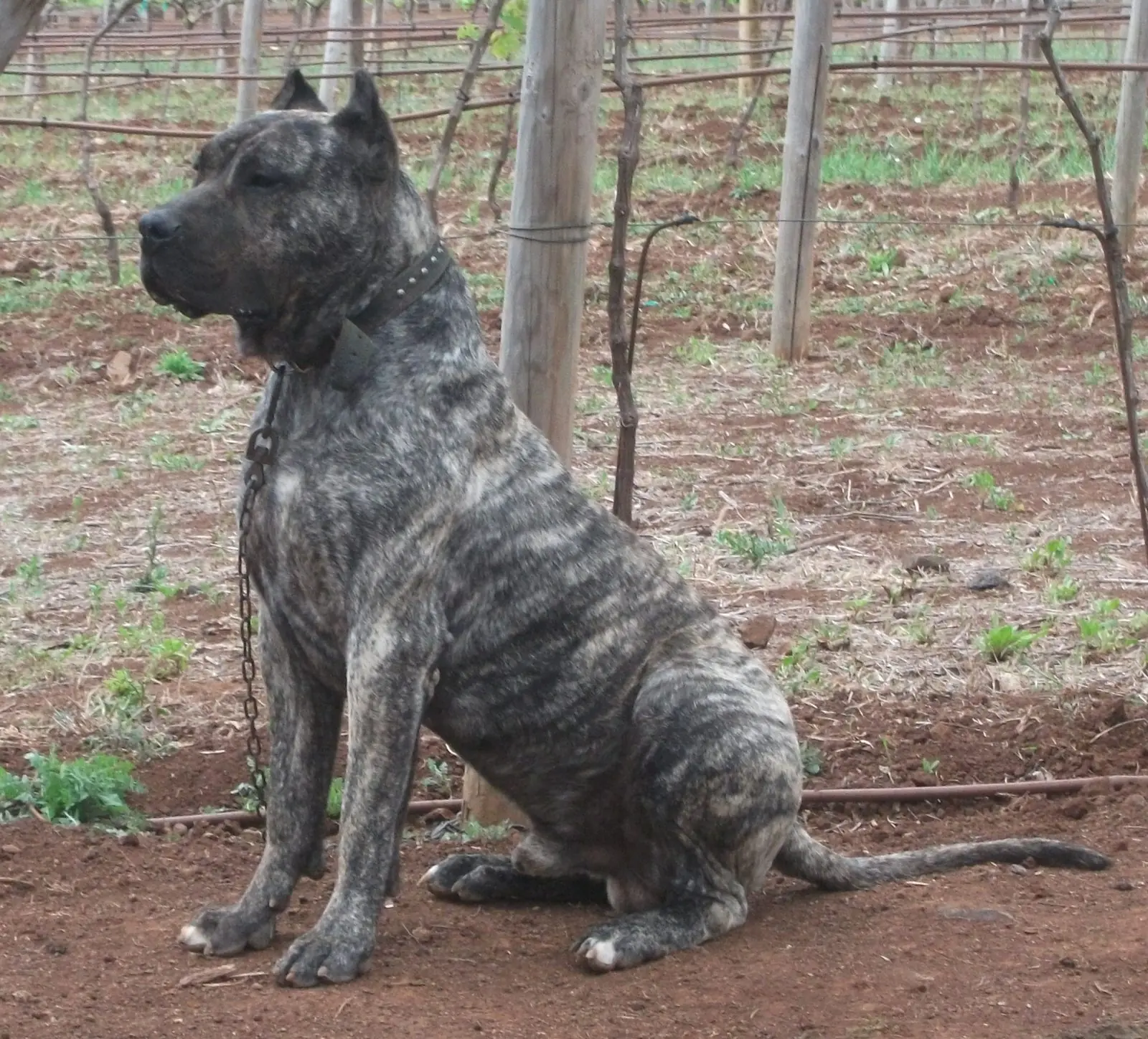
Photo: Felorodriguez · CC BY-SA 3.0 · Wikimedia Commons · scaled
The Presa Canario: a farm dog with a fighting past
The Presa Canario, whose name means roughly "Canarian catch dog", is the islands' mastiff. It descends from the Bardino of Fuerteventura crossed with heavier molosser-type dogs brought in after the conquest. Breed histories often say British dogs played a particular part in the late nineteenth century, when British merchants and residents arrived in numbers, an episode covered on our page about the British in the Canaries.
Its traditional jobs were guarding farms, controlling half-wild cattle by gripping and holding them, and, less proudly, fighting. Dog fights were a popular entertainment in the islands for generations before they were outlawed, and the breed's reputation still carries that history. By the 1960s the Presa was close to extinction as farming declined and foreign breeds became fashionable.
The revival began with island breeders in the 1970s and 1980s. The Club Español del Presa Canario was founded in 1982, the Spanish kennel club approved a standard in 1989, and in 1991 the Canarian parliament made the dog the natural symbol of Gran Canaria. International recognition took longer: the Fédération Cynologique Internationale accepted the breed provisionally in 2001 under the name Dogo Canario, fully in 2011, and changed the name back to Presa Canario in 2018. If you have seen both names, they are the same dog.
The dogs in the square are bronze, not bred. The eight dogs outside the cathedral of Santa Ana in Las Palmas are nineteenth-century statues, not a portrait of any modern breed, although locals often call them Presas. They are a favourite photo stop in Vegueta, the old town of Las Palmas, and a good place to start if you want to see why Gran Canaria treats the dog as its emblem.
What a Presa Canario is like
This is a large, square, very muscular dog with a broad, heavy head and a short coat in fawn, brindle or black, often with a dark mask. Under the current FCI standard, males stand about 61 to 66 cm at the shoulder and weigh roughly 45 to 57 kg; females are a little smaller. Older standards allowed heavier dogs, and you will still see some very big individuals.
Breeders describe a calm, confident dog that is devoted to its family and wary of strangers, which is exactly what a farm guard should be. The same traits make it a demanding dog for an inexperienced owner: it needs early socialisation, firm and consistent handling and a lot of space. It is not a breed to buy on impulse after a holiday. A UK study of breed lifespans put its median life expectancy at 7.7 years, well below the average for all dogs, which is typical of very large breeds.
Where the Presa is restricted abroad
The breed's guarding instincts, size and fighting history mean some countries restrict it. The best-known case in the English-speaking world came in 2001, when a woman was killed by two Presa Canarios in a San Francisco apartment building, a case that put the breed on front pages and into legislation debates far from the islands.
- United Kingdom: the Presa Canario is not on the list of banned dog types for England and Wales. The gov.uk list names the Pit Bull Terrier, Japanese Tosa, Dogo Argentino, Fila Brasileiro and XL Bully. Scotland and Northern Ireland have their own rules, and any dog can be dealt with under dangerous-dog law if it is out of control.
- New Zealand: the Dog Control Act 1996 prohibits importing any dog that is wholly or predominantly Perro de Presa Canario, according to New Zealand Customs.
- Australia: the Australian Border Force lists the Perro de Presa Canario among the dangerous breeds whose import is prohibited, alongside the Dogo Argentino, Fila Brasileiro, Japanese Tosa and American Pit Bull Terrier.
Rules elsewhere change and sometimes differ between regions within a country, so anyone thinking of owning or moving with one should check the current law at home before buying. Within Spain, large and powerful dogs can come under the rules for potentially dangerous dogs, which involve licensing and insurance; a local vet or the town hall can tell you what applies. If you are bringing your own dog on holiday, our guide to travelling with a dog to the Canaries covers the practical side.
The Bardino Majorero of Fuerteventura
The Perro Majorero, known locally as the Bardino, is the dog of Fuerteventura, and it is the one most closely tied to the island's traditional life. It is a medium-to-large, strongly built dog with a short, rough coat, very often in dark brindled shades, and a watchful, reserved manner with strangers. Its job was to guard the goat herds, the farmyard and the house, and to help move goats across open country with very little human help.
Like the Presa, it nearly disappeared. Farming declined, foreign breeds arrived and careless crossbreeding diluted the type. The recovery started with a first breed show at Gran Tarajal in 1979, and the Spanish kennel club recognised it as a native breed on 14 April 1994. A conservation association now runs a breeding plan and has handed puppies to its members and to goat farmers to rebuild the population on the island. The goats the Bardino works with produce the milk for Fuerteventura's famous cheese, so the dog and the island's best-known food are part of the same system; our page on Canarian cheeses explains the rest.
On the island you are most likely to see Bardinos at goat farms, around the villages of the interior and at agricultural fairs. Treat them as working guards: do not walk into a farmyard uninvited, however friendly the dog looks from the road.
The Podenco Canario, the rabbit hound
The Podenco Canario is the dog you will hear before you see. It is a slim, elegant hound with large upright ears, a fine head and a short coat in red, white or a mix of the two, built for speed and agility over rough volcanic ground. The FCI recognised it in 1987. A smaller type is also bred in the islands, alongside the standard hound.
Its work is rabbit hunting, and the method is old. Packs of podencos find and chase the rabbit, often working with ferrets that flush it from burrows and stone walls; the Canary Islands government's annual hunting orders still set out days when rabbits may be hunted with dogs and ferrets. When the dogs close in, they give a repetitive, staccato bark that hunters know well. If you walk in the hills on a Sunday in the late-summer and autumn season and hear that sound below you, it is a pack at work. The result often ends up on the table as conejo en salmorejo, the islands' classic rabbit dish.
The podenco is often said to descend from the hunting dogs of ancient Egypt, brought by Phoenician or North African seafarers. It makes a fine story and you will hear it repeated, but genetic studies have found that the breed is no more ancient than other European hunting dogs. Its look is old; its pedigree is ordinary.
Other island dogs
La Palma has its own working sheepdog, the pastor garafiano, named after the remote northern municipality of Garafía, where it was traditionally used with flocks on the steep slopes. Other islands have local herding types that are known to farmers and enthusiasts but not formally recognised as breeds. They are less famous than the Presa, but they are closer to what most island dogs actually were: hard-working, unglamorous animals bred for a specific landscape.
You will also see a great many podenco crosses and mixed-breed dogs in rescue centres across the islands. Hunting dogs that do not make the grade are sometimes abandoned, and local shelters work hard to rehome them, including abroad. If you want to help while you are here, volunteering to walk shelter dogs is a common and welcome way to do it.
The islands and their dogs, in short
The Canary Islands have three dogs worth knowing: the Presa Canario, Gran Canaria's powerful farm mastiff and official symbol, restricted in some countries; the Bardino of Fuerteventura, the tough goat dog behind the Presa and behind the island's cheese; and the Podenco Canario, the rabbit hound you hear in the hills on autumn Sundays. Look for them on farms and in the countryside rather than at tourist sights, and they tell you more about old island life than many museums. For the islands' other animals, from giant lizards to wild canaries, start with our overview of the wildlife of the Canary Islands.