Here's the fact that surprises almost everyone: the Canary Islands are not named after the little yellow birds — it's the other way round. The islands take their name from the Latin Canariae Insulae, "the islands of the dogs", and the canary bird was later named after them. That's just the start. From Spain's highest mountain and a whistled language to black-and-gold sands and some of the darkest skies on Earth, these eight Atlantic islands are full of the genuinely remarkable. Here are the best fun facts to file away before you go.
1. Named after dogs, not birds
The name comes from the Latin Canariae Insulae — the "islands of the dogs" — a description the Romans applied after reports of large dogs living there (some say it may instead refer to monk seals, once called "sea dogs"). Either way, the wild little songbird we call the canary was named after the islands, its native home, and not the reverse. So the bird is Canarian, but the islands are emphatically not "the bird islands".
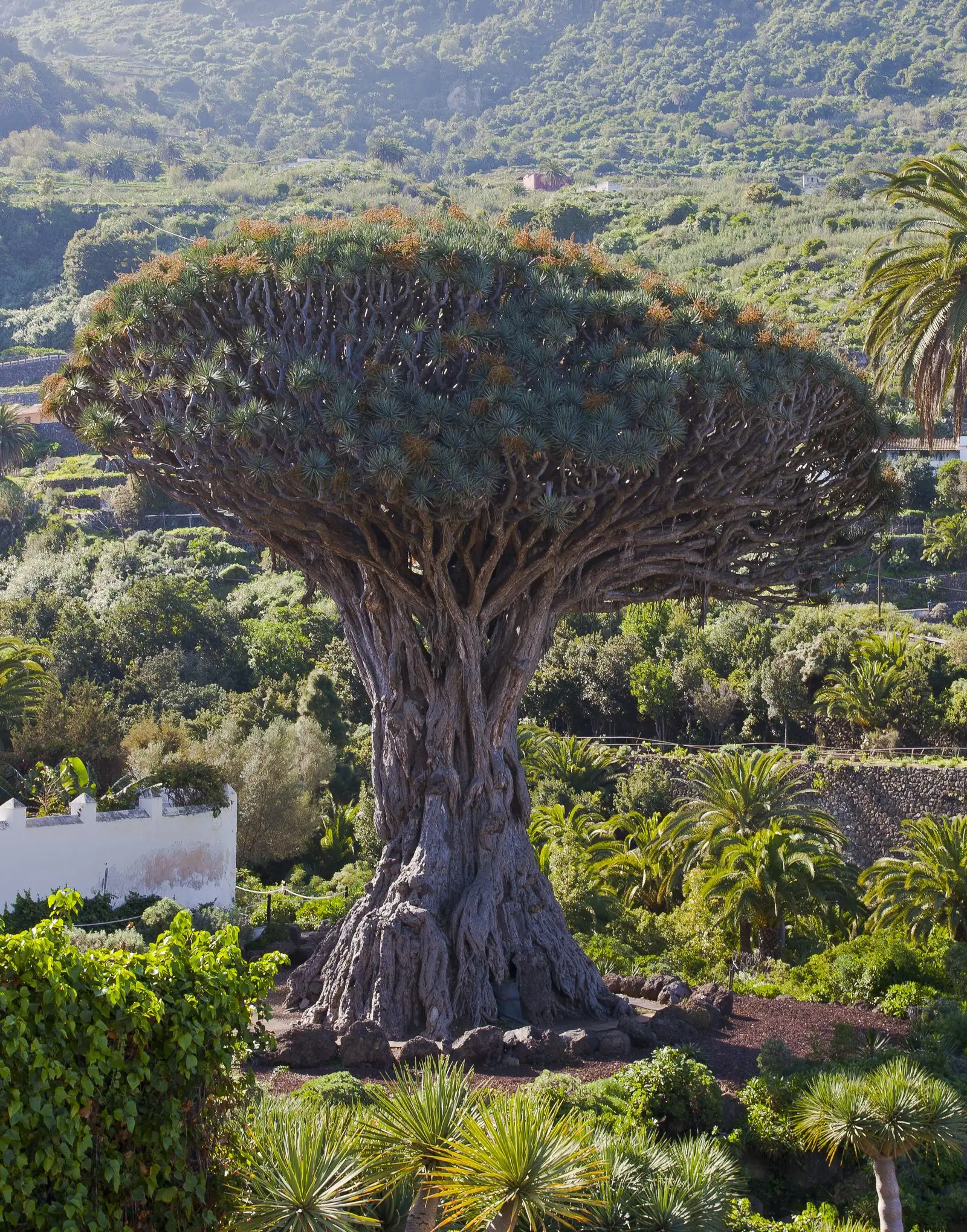
Photo: Diego Delso · CC BY-SA 3.0 · Wikimedia Commons · scaled
2. Teide is Spain's highest peak — and a giant among volcanoes
Mount Teide on Tenerife rises to 3,715 metres, making it the highest mountain in all of Spain. More astonishingly, measured from its base on the Atlantic seabed rather than from sea level, Teide is one of the tallest volcanoes on the planet — often ranked the third-highest volcanic structure on Earth. Its snow-dusted winter summit floating above the clouds is one of the great Canary sights. Plan your visit with our Mount Teide guide.
3. There's a language you whistle
On the island of La Gomera, locals developed Silbo Gomero, a whistled form of Spanish that can carry across the island's deep ravines for several kilometres — far further than a shout. Once used by shepherds and messengers, it's now taught in schools and recognised by UNESCO as a masterpiece of human heritage. Hearing it echo across a valley is unforgettable. Discover it in our guide to the Silbo whistled language.
4. Black sand and golden sand
Thanks to their volcanic origins, many Canary beaches are made of dramatic black or dark-grey sand — the northern coasts of Tenerife and La Palma especially. Yet the islands also boast dazzling golden beaches, some of it fine pale sand carried on the wind, most famously across Fuerteventura and the great dune fields of Gran Canaria. Few places let you swap black volcanic sand for Saharan gold in a single short flight. Browse them all from our beaches hub.
The golden dunes of Maspalomas and Corralejo look and feel like a slice of the Sahara — which, given the islands' position, is not far from the truth.
5. Closer to Africa than to Europe
Although they are Spanish and European, the Canaries lie off the northwest coast of Africa — the easternmost island, Fuerteventura, sits only around 100 kilometres from the Moroccan coast. That African proximity explains the warm, dry, desert-edge climate, the occasional dust-laden calima wind and those Saharan-style dunes. We untangle the geography in are the Canary Islands in Spain or Africa?
6. Eternal spring, all year round
The Canaries are famous for a climate so mild and steady it's often called "eternal spring". Cooled by the Atlantic and the trade winds, the islands enjoy warm, gentle temperatures every month of the year, which is exactly why they became Europe's favourite winter-sun escape. You can swim in December and rarely swelter in July — a rare and wonderful balance.
7. Some of the best stargazing on Earth
The high peaks of La Palma and Tenerife host world-class astronomical observatories, including the giant telescopes atop La Palma's Roque de los Muchachos. Clean Atlantic air, high altitude and strict "sky laws" limiting light pollution give the western islands some of the darkest, clearest night skies anywhere — La Palma is even a designated Starlight Reserve. See our guide to stargazing in the Canary Islands.
8. Four national parks
For such small islands, the Canaries are extraordinarily rich in protected nature — home to four national parks: Teide on Tenerife, Timanfaya's fire mountains on Lanzarote, the ancient laurel forest of Garajonay on La Gomera, and the vast crater of Caldera de Taburiente on La Palma. Between them they range from volcanic desert to misty prehistoric woodland.
9. Dragon trees straight out of legend
The islands are home to the drago or Canarian dragon tree, a strange, umbrella-shaped survivor from a prehistoric age whose sap runs red like "dragon's blood". The most famous specimen, at Icod de los Vinos in Tenerife, is thought to be many centuries old and is one of the island's living emblems. Read more in our guide to the Canarian dragon tree.
10. A slice of the Sahara on Fuerteventura
Fuerteventura's protected Corralejo dunes are a genuine desert of pale, wind-blown sand rolling right down to a turquoise sea — a landscape more North African than European, and one of the most photographed sights in the islands. It's a vivid reminder of just how close these Atlantic islands sit to the great desert across the water.
The bottom line
From dogs rather than birds to whistled words, giant volcanoes, black-and-gold beaches and skies made for astronomers, the Canary Islands are far stranger and more wonderful than a simple beach break suggests. Keep these facts in mind as you travel and you'll see the islands with fresh eyes — start exploring from the geography of the islands or pick your favourite marvel above and dive in.