On the steep, ravine-cut island of La Gomera, people can hold a conversation across a valley two or three kilometres wide — without shouting a word, using only a piercing whistle. This is Silbo Gomero, the whistled language of the island: not a code or a set of signals, but a genuine language, a whistled form of Spanish that can express anything the spoken word can. Once close to extinction, it was saved by the island's schools and honoured by UNESCO, and it remains one of the most extraordinary living traditions in the Canaries.
Hear it echo between the cliffs of La Gomera for the first time and it stops you dead — an eerie, birdlike trilling that carries impossibly far. Here's how it works, where it came from, and how it very nearly disappeared.
How Silbo works
Silbo isn't a fixed vocabulary of whistled words. Instead, whistlers "translate" spoken Spanish into whistles in real time, replacing the sounds of speech with tones. The whistle carries two things at once: pitch (higher or lower) and continuity (interrupted or unbroken). By varying these, a skilled silbador reproduces the vowels and consonants of Spanish closely enough that another islander can understand full sentences.
Because the human whistle can only convey a simplified version of speech, several spoken sounds map onto the same whistle — so listeners rely on context to tell them apart, just as we do with homophones in ordinary conversation. A practised whistler fingers the mouth to shape the notes and cups a hand to aim the sound. The payoff is astonishing range: a whistle cuts through wind and distance far better than a voice, carrying for kilometres across the barrancos.
The best way to picture it: Silbo is to Spanish roughly what Morse is to written English — a different channel for the same language. But unlike Morse, it's fast, fluid and expressive enough for genuine everyday conversation.
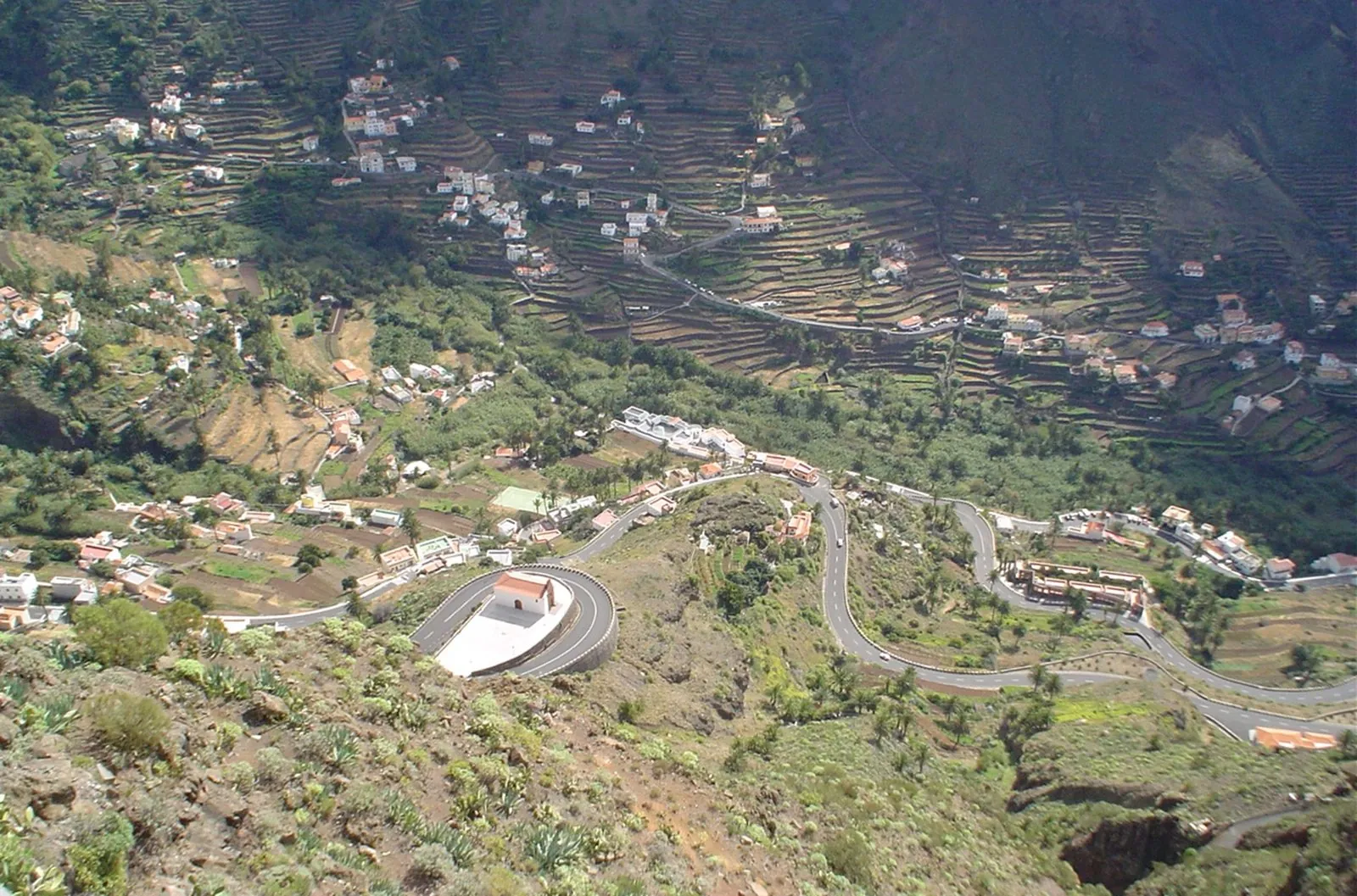
Photo: Noemi M. M. · CC BY-SA 4.0 · Wikimedia Commons · scaled
Why it exists: an island of ravines
Silbo is a direct answer to La Gomera's landscape. The island is a near-circular dome slashed by deep, radiating ravines, so that two farms a short distance apart as the crow flies might be an hour's hard walking apart on foot. Before roads, telephones and mobiles, a whistle that carried across a valley was worth an hour's climb saved. Shepherds and farmers used Silbo to pass news, call for help, announce births and deaths, warn of danger, or simply chat between distant hillsides.
Interestingly, the technique appears to predate Spanish entirely. The island's aboriginal Guanche inhabitants are thought to have whistled their own language in the same way; when Castilian arrived after the conquest, islanders simply adapted the whistling method to the new tongue. So Silbo is both very old and, in its Spanish form, a survivor of colonisation.
The brush with extinction
For most of history Silbo was essential, and every Gomeran learned it. Then, in the mid-20th century, it collapsed almost overnight. Roads, telephones and later mobile phones removed the practical need to whistle across valleys. A wave of emigration — many Gomerans left for Venezuela and elsewhere — drained the island of young people. By the 1980s Silbo was fading fast, kept alive mainly by an older generation, and there was a real fear it would die with them.
Silbo's near-death is a cautionary tale about intangible heritage: a tradition can survive for centuries and then vanish within a single generation once the technology that made it necessary disappears. What saved it was a deliberate decision not to let that happen.
Saved in the classroom
The rescue came through the schools. From the late 1990s the local authorities made Silbo Gomero a compulsory subject in the island's primary schools, taught by trained silbadores. A whole new generation grew up whistling again — this time in the classroom rather than the fields. The revival worked: thousands of Gomeran children now learn Silbo, and the language is no longer whistled out of necessity but preserved out of pride and identity.
In 2009 UNESCO inscribed Silbo Gomero on its list of the Intangible Cultural Heritage of Humanity — international recognition that this whistled language is a treasure worth protecting. It remains the only whistled language in the world that is fully developed, widely practised by a large community, and safeguarded in this way.
Where to hear it
You don't have to hope for luck. Silbo is regularly demonstrated for visitors:
- Restaurant demonstrations. Several restaurants near Garajonay National Park and around the island lay on Silbo demonstrations during lunch, especially for coach tours crossing the island — a whistler will "call" across the dining room and translate.
- Cultural centres and school visits. Island cultural events and museums showcase Silbo, and its place in Gomeran life is explained alongside the island's other traditions.
- Day trips from Tenerife. Organised excursions from Tenerife's south almost always include a Silbo demonstration as a highlight, usually paired with the laurel forest of Garajonay.
Part of a wider island culture
Silbo doesn't stand alone — it's one thread in La Gomera's rich, distinctive culture, alongside its drumming, dancing and the palm honey and almogrote of its kitchens. Our guide to Canarian music and folklore sets it in that wider picture of island tradition.
Why it stays with you
Of all the things you can encounter in the Canaries, Silbo Gomero is among the most quietly astonishing. It's proof that human beings, faced with a landscape that would defeat ordinary speech, will invent an entirely new way to talk — and that a community can choose, against the odds, to keep such a thing alive. Stand on a Gomeran ridge, hear a whistle answer from the far side of a green ravine, and you're hearing a conversation that has echoed across these valleys for a very, very long time.