Teno Rural Park is Tenerife at its wildest and most beautiful — a rugged peninsula of towering ravines, remote hamlets, terraced hillsides and dizzying coastal cliffs in the island's far north-west. This is the Tenerife that existed long before the resorts: a place of goat tracks and old stone houses, of the legendary village of Masca and the wave-battered lighthouse at Punta de Teno, and of walks and drives that stay with you for years. If you want to feel how untamed Tenerife can still be, Teno is where to go.
An ancient, protected landscape
The Teno massif is one of the oldest parts of the island, a great block of volcanic rock carved over millions of years into a maze of deep barrancos (ravines) and knife-edged ridges. Much of it is a protected rural park, safeguarding not just the dramatic scenery but a way of life: scattered hamlets, dry-stone terraces, small vineyards and the traditional farming that still clings to these slopes. The park runs from pine-dusted heights down to sheer sea cliffs, and the contrast — green ridges above, black-and-blue Atlantic below — is unforgettable.
Because it's remote and hard to reach, Teno has kept a slower, older feel than almost anywhere else on the island. Roads twist and cling; villages sit at the end of long, winding descents; and the sense of getting properly off the beaten track is real.
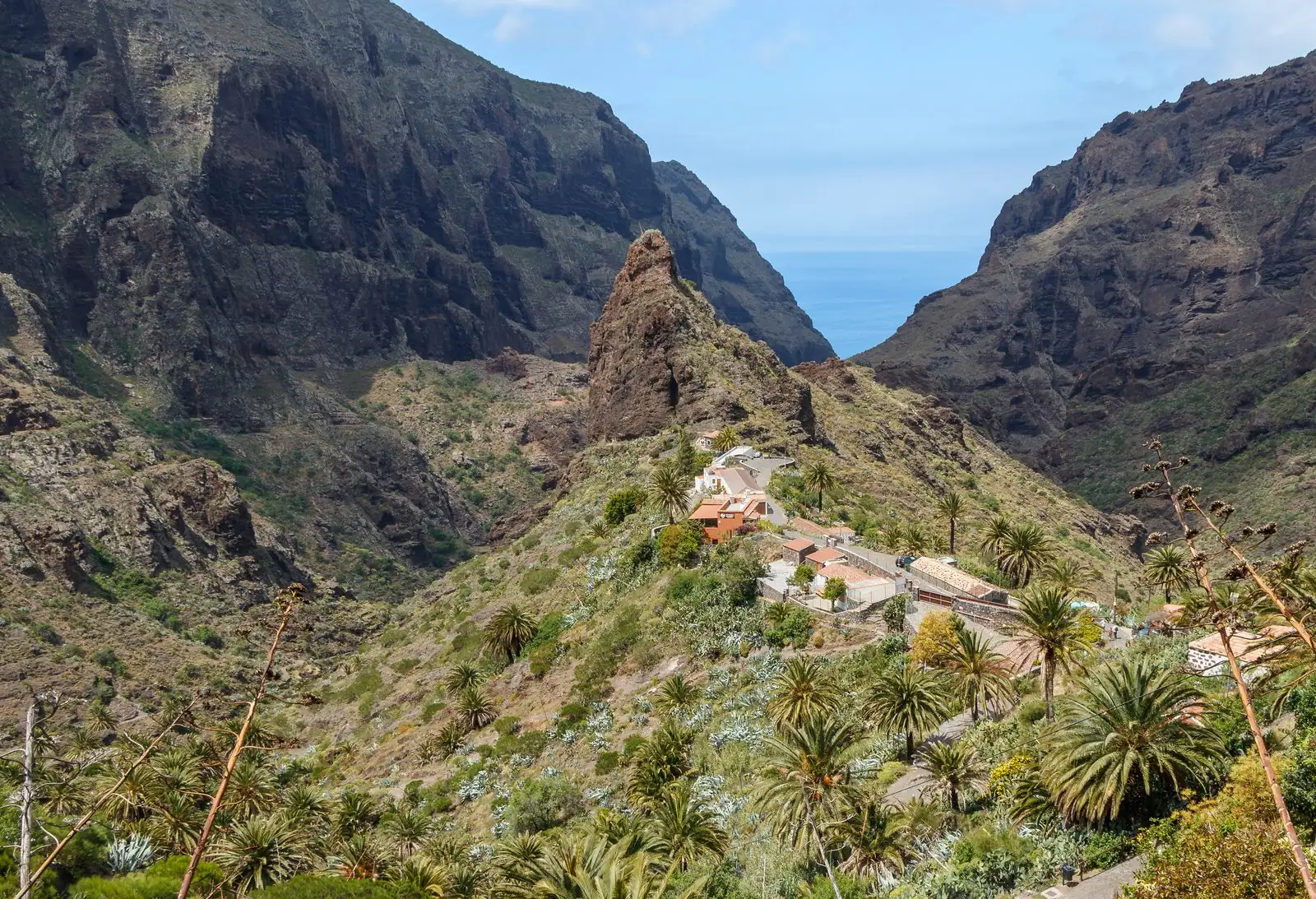
Photo: H. Zell · CC BY-SA 3.0 · Wikimedia Commons · scaled
Masca, the village in the gorge
Teno's most famous corner is Masca, a tiny hamlet of stone houses draped over a ridge deep in the mountains, ringed by soaring rock pinnacles. The approach alone — a serpentine road of hairpin bends — is an event, and the views from the village and its miradors are among the most spectacular in the Canaries. From here the celebrated Masca gorge walk plunges down towards the sea, though access to the barranco is managed and sometimes restricted, so always check current rules before planning to hike it.
Drive Teno's roads with real care. The route to Masca and around the massif is narrow, steep and full of blind hairpins, with buses and cyclists to meet. Go slow, use the passing places, avoid the busiest midday hours, and never attempt it if you're a nervous mountain driver. Parking in Masca is very limited.
Punta de Teno at the edge of the island
At the western tip, the road runs out at Punta de Teno, a low, wind-scoured headland with an old lighthouse and staggering views back along the cliffs towards Los Gigantes. It's one of the best sunset spots on Tenerife and a magical place to feel the raw power of the Atlantic. To protect the fragile access road from rockfalls and traffic, private cars are often barred at busy times and you take a shuttle bus instead — check the current arrangements before you set off.
Hamlets, footpaths and the old ways
Beyond the headline sights, Teno rewards slow exploration. Little villages such as El Palmar, Las Portelas and Teno Alto sit among terraces and grazing land, and Teno Alto in particular is known for its farmhouse goat's cheese — worth seeking out with a glass of local wine. A superb network of old paths threads the massif, and this is prime territory for hiking on Tenerife: routes range from gentle strolls between hamlets to serious ravine descents, all through scenery that feels wonderfully lost in time.
Come prepared and start early. There's little shade, few facilities and patchy phone signal out here. Bring water, sun protection, sturdy shoes and a windproof layer, carry cash for village cafés, and set off in the morning to enjoy clear light and dodge both crowds and afternoon cloud rolling in off the sea.
Making a day of it
Teno pairs naturally with the pretty north-western towns just outside the park — whitewashed Garachico by the sea and the coastal resorts around Los Gigantes, with their famous cliffs. A classic day loops up through the massif to Masca, out to Punta de Teno, and back along the coast, with a village lunch somewhere in between. It's a brilliant contrast to a holiday based in the sunny south, and shows just how varied a single island can be.
You'll want a hire car to explore properly, as public transport into the heart of Teno is limited; from the southern resorts allow a good 90 minutes or so each way, and build in plenty of time for the slow, spectacular mountain roads.
Ravines, goat tracks and a village in the clouds — Teno is the Tenerife the brochures forget.
Give it a full, unhurried day, drive gently, and let the wild north-west work its magic. Teno Rural Park is one of the great things to do on Tenerife — proof that the island's finest scenery lies well away from the sunbeds.