Playa Paraíso is a small, mostly modern hotel resort on the south-west coast of Tenerife, in the municipality of Adeje, about 25 km from Tenerife South airport. It sits on low cliffs between the northern end of Costa Adeje and the neighbouring resort of Callao Salvaje, and it is best known for the Hard Rock Hotel Tenerife, whose towers you can see from a long way down the coast. Despite the name, there is no big golden beach here: the shore is dark rock broken by a handful of small coves.
What you get instead is a quieter base than the main strip, big resort hotels with their own pools, a clear view of La Gomera across the water and some of the best sunsets in the south. Most people who stay here spend their days around the pool or take a short drive or bus ride to the sandy beaches further along the coast.
This page explains how Playa Paraíso fits together with Callao Salvaje next door, what the coast is really like, which kinds of hotel dominate, and who will be happy here and who will not.
Where it is, and where Callao Salvaje begins
Drive north-west out of La Caleta, the fishing-village end of Costa Adeje, and the coast road climbs onto a rocky shelf. The first development you reach is Playa Paraíso; a little further on, and almost seamlessly, comes Callao Salvaje. Beyond that the road runs on towards Armeñime, Playa San Juan and eventually Los Gigantes. Officially both resorts are neighbourhoods of the wider Costa Adeje area, which is why addresses and bus timetables sometimes lump them together.
The two are easy to confuse because they run into each other, but they have slightly different characters. Playa Paraíso is the hotel end, with a cluster of large four- and five-star resorts along the cliff. Callao Salvaje is more residential and apartment-based, with a small commercial centre, bars that stay open into the evening and a larger share of long-stay visitors and foreign residents. Neither has a separate town centre in the Spanish sense; there is no church square or market street, just hotels, apartments, supermarkets and a few strips of shops and restaurants.
The names say something about the coast. A callao in Canarian Spanish is a smooth, rounded beach stone, the kind that rattles in the backwash, and salvaje means wild. One of the coves in Playa Paraíso is called Las Galgas, the greyhounds. None of these names promises sand, and that is honest.
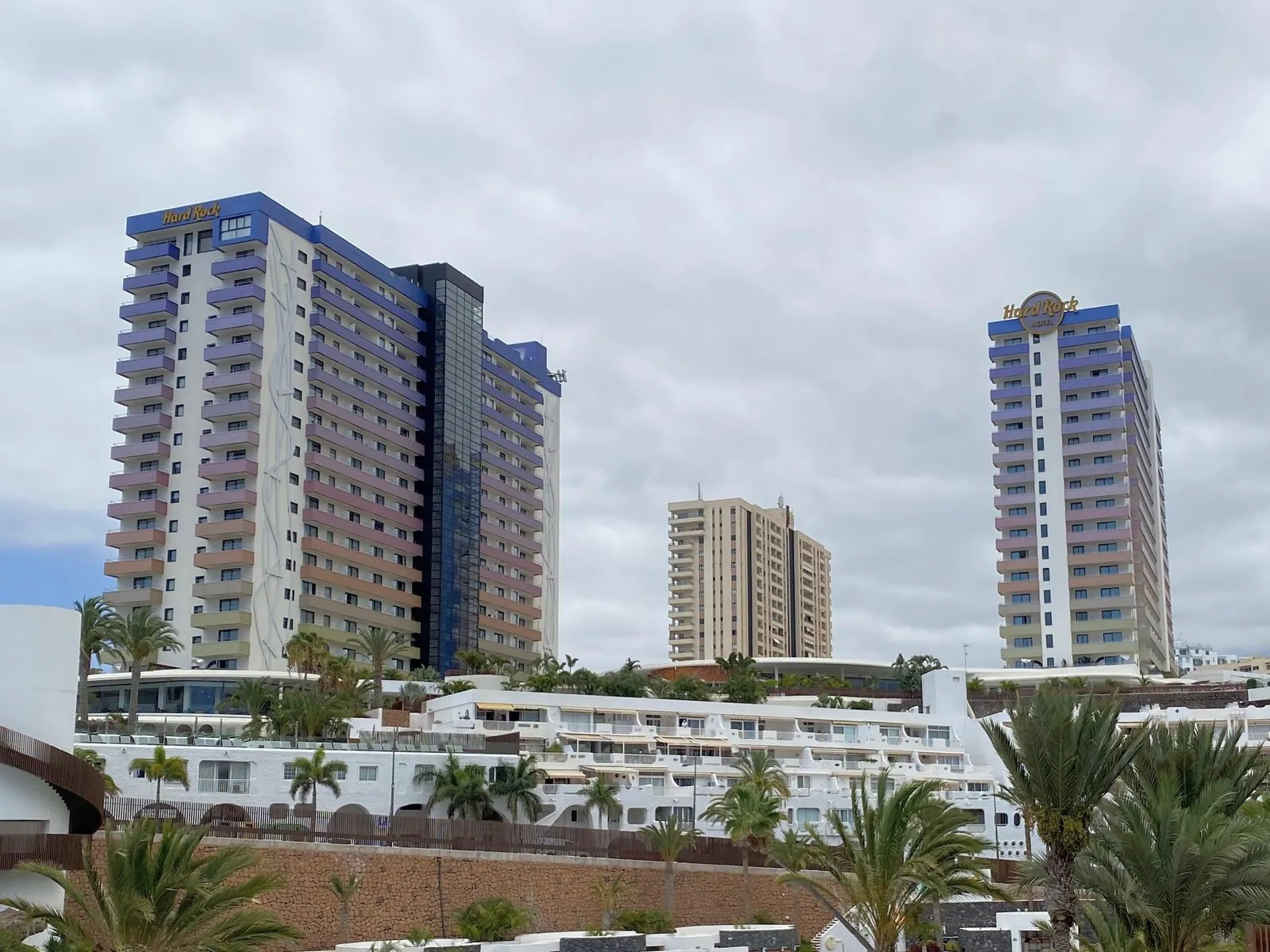
Photo: -wuppertaler · CC BY 4.0 · Wikimedia Commons · scaled
The Hard Rock Hotel and its neighbours
Yes, the Hard Rock Hotel Tenerife is here. Its own website gives the address as Avenida de Adeje 300 in Playa Paraíso, and it is easily the largest landmark in the resort. It opened at the end of 2016 after a rebuild of an older Fiesta Hotel complex; Diario de Avisos put the investment at around €70 million at the time and reported that it was the second Hard Rock hotel in Spain, after Ibiza. It is run by the Palladium Hotel Group.
The hotel is big, loud in a cheerful way and built around pools, with music, entertainment and a separate adults-only pool area in front of its tallest tower. The hotel says the Lagoon pool has direct access down to the shore. It also says that improvement works are scheduled in parts of the complex between September and December 2026, with the hotel staying open; if you are booking for the last weeks of the year, ask which areas are affected.
Around it, a handful of other large resorts share the same cliff and, in several cases, the same street address. At the time of writing they include the Gran Hotel Roca Nivaria, the H10 Atlantic Sunset, two Bahía Príncipe Sunlight properties and the Riu Buenavista. Names and operators change more often than the buildings do, so treat that list as a guide rather than a directory. Most work on an all-inclusive or half-board basis, which shapes the whole resort: a lot of guests eat in, and the independent restaurant scene is thinner than in Costa Adeje.
Why the resort was "relaunched". When the Hard Rock project was announced, Adeje council, the island government and the Chamber of Commerce presented a joint plan in May 2016 to improve the shops, restaurants and public spaces of Playa Paraíso. Local business owners had complained that younger visitors had drifted away from this part of the south over the previous fifteen years, and the hotel was aimed at guests aged roughly 35 to 45. That is the story behind the newer, smarter feel of parts of the resort, and the older, plainer feel of others.
The coast: coves, rock and very little sand
The resort's name is the biggest trap for first-timers. The shoreline below the hotels is mostly low black lava cliff and boulder, with a series of small coves in between. Maps show Playa El Pinque, Playa de las Salinas and Playa Las Galgas along the Playa Paraíso stretch; in practice these are short pockets of dark grit and stone rather than beaches you would spend a day on. When the swell is up, which happens more often on this exposed coast than in the sheltered bays of Las Américas, the sea breaks hard on the rocks and swimming from the shore is a bad idea.
On calm days it is a different picture. The water is clear, the rocks are full of fish and crabs, and confident swimmers with a mask can enjoy themselves. Entry is over rock or stones, so water shoes help, and there are no lifeguards on most of these coves. Check the flags and the state of the sea, not just the weather. If you want lifeguarded sand, the closest proper beaches are back towards Costa Adeje, where Playa del Duque and the other beaches of the Fañabé strip are a short drive or taxi away.
Do not judge the sea from the pool deck. From a sunbed on a clifftop terrace the Atlantic can look flat when there is a long swell running underneath. Waves on this stretch can wash right over the rock shelves. Go down and watch for a few minutes before getting in, and stay out if the water is surging up the stones.
El Puertito and the turtles
The single most popular outing from Playa Paraíso is on its doorstep. Just south-east of the hotels, back towards La Caleta, is El Puertito, a small, sheltered cove with a scatter of fishermen's houses and a little beach. Green turtles feed in the bay, and they are seen there so often that snorkel tours and boat trips come in daily. Our page on the sea turtles of the Canaries explains why they gather in spots like this.
Go early. By late morning the cove can be crowded with snorkel groups, kayaks and boats, and parking along the access road is limited and informal. Do not touch or feed the turtles, which changes their behaviour and can make them ill, and keep a respectful distance even when they swim right up to you. Between El Puertito and La Caleta, a rough path leads to Playa de Diego Hernández, a pale, secluded cove reached only on foot that attracts walkers and naturists. Wear proper shoes and carry water; there is no shade and no kiosk.
Further offshore, this coast is one of the best places in Europe to see pilot whales and dolphins, and many whale and dolphin trips leave from the harbours of Puerto Colón and Los Cristianos, a short drive south.
Callao Salvaje next door
Callao Salvaje, a few minutes' walk to the north-west, fills in what Playa Paraíso lacks. It has its own small beach, Playa de Ajabo, a small cove of dark sand below the cliffs that is pleasant for a swim on calm days. The streets behind it hold apartment complexes, supermarkets, cafés and a handful of bars and restaurants with a more local, residential feel than the hotel strip.
Many visitors to Playa Paraíso end up eating in Callao Salvaje at least once, simply because there is more choice outside the hotels. It is also a good place to look if you would rather rent an apartment than stay in a big resort: prices are often lower, kitchens make self-catering easy, and you are still close to the turtle cove and the sunsets. The two places share the same coast, the same weather and the same bus routes, so think of them as one area with a hotel end and an apartment end.
Sunsets, La Gomera and the weather
Because the coast faces west and south-west, Playa Paraíso gets the late light that the east-facing resorts miss. On most evenings the sun goes down beside or behind La Gomera, whose outline sits on the horizon about 30 km away, and the hotel terraces and the cliff path fill up with people watching it. It is one of the reasons the resort turns up on lists of the best sunset spots in the islands.
The weather is typical of Tenerife's dry south-west: sunny for most of the year, very little rain, and warm even in winter, although evenings in January and February can feel cool on an open terrace when the breeze picks up. The cliffs mean more wind than in the sheltered bays of Las Américas on some afternoons, which is pleasant in summer and occasionally a nuisance by the pool in winter. Cloud does sometimes sit over this side of the island, but it is rarely a whole-day affair.
Getting there and getting around
Tenerife South airport is roughly 25 km away along the TF-1 motorway, and a taxi or transfer usually takes around half an hour in normal traffic. Our page on getting from Tenerife South airport compares taxis, shuttles and buses. Uber operates in Adeje and the rest of the south of the island; the details are on our page about taxis and Uber in the Canaries.
TITSA buses run along the coast road through Playa Paraíso and Callao Salvaje, linking them with Costa Adeje, Las Américas, Los Cristianos and the west coast towards Los Gigantes. Frequencies are lower than on the main resort strip, especially in the evening, so check the current timetable on the TITSA bus network page or the TITSA app rather than turning up and hoping. Many guests hire a car for a few days: parking at the big hotels is usually straightforward, and Teide, Masca and the west coast are all within an hour or so.
For families, Siam Park in Costa Adeje is a 15 to 20 minute drive away and is the most common day out from the resort. On foot, the hotels are spread along the cliff and there are some steep streets, so the resort is less flat and pushchair-friendly than the seafront promenades further south.
Who it suits, and who should look elsewhere
Playa Paraíso works best for people who mean to spend most of their holiday at their hotel. Couples and families who want a large resort with several pools, sea views and a lively but contained atmosphere will be happy, and Hard Rock fans will obviously find what they came for. Couples who want quieter, adult-oriented hotels have choices too; several of the big hotels here have adults-only pools or wings. The sunsets, the turtle cove and the calmer streets are real advantages over the busier strip.
It is a poor fit if you want to walk out of your door onto a sandy beach, browse a long promenade of shops and restaurants in the evening, or feel you are in a Canarian town. People who want nightlife beyond the hotel bars will spend money on taxis to Las Américas. If any of those matter, compare this area with the other bases in our guide to where to stay in Tenerife before you book.
Choosing Playa Paraíso, in a sentence or two
Book Playa Paraíso for the hotel, the view and the evening light, not for the beach. Pair it with Callao Salvaje for apartments, local bars and the cove at Ajabo, use El Puertito for the turtles, and accept that sand means a short trip back towards Costa Adeje. For a pool-centred holiday on the sunny side of Tenerife, with La Gomera on the horizon at dinner, it does exactly what it promises.