After the feathers and mayhem of Carnival, the Canary Islands turn quiet and solemn for Holy Week — a very different, and quietly unforgettable, kind of spectacle. Semana Santa, the week leading up to Easter Sunday, brings hooded processions winding through candlelit old towns, ornate religious floats carried on the shoulders of brotherhoods, the slow beat of drums and the scent of incense drifting over cobbled streets. It's less flamboyant than the great Holy Weeks of Seville or Málaga, but on islands like Tenerife and Gran Canaria it is deeply atmospheric, beautifully staged and rooted in centuries of tradition.
Here's what Semana Santa involves in the Canaries — where to see the finest processions, what the rituals mean, and what to expect if your trip falls over Easter.
Easter is a movable feast: Holy Week can fall anywhere from late March to late April depending on the year. It's also a major Spanish holiday, so roads, flights and hotels get busy and prices rise. Check exact dates and local procession timetables before you travel. Our guide to the Canary Islands in April covers the wider seasonal picture.
What Semana Santa is
Semana Santa marks the Passion of Christ — his final days, crucifixion and resurrection — through a sequence of religious processions staged across the week. Each is organised by a cofradía or hermandad (brotherhood), whose members walk the route in traditional robes and tall pointed hoods (capirotes), sometimes barefoot, carrying candles or walking in penitent silence. At the heart of every procession are the pasos — elaborate floats bearing statues of Christ and the Virgin Mary, many of them genuine works of art, borne slowly through the streets to the beat of muffled drums and the mournful notes of brass bands.
Those tall pointed hoods have nothing to do with any other group that later adopted a similar shape — they are a centuries-old Spanish symbol of penitence and anonymity. Understanding that in advance saves a lot of confusion for first-time visitors.
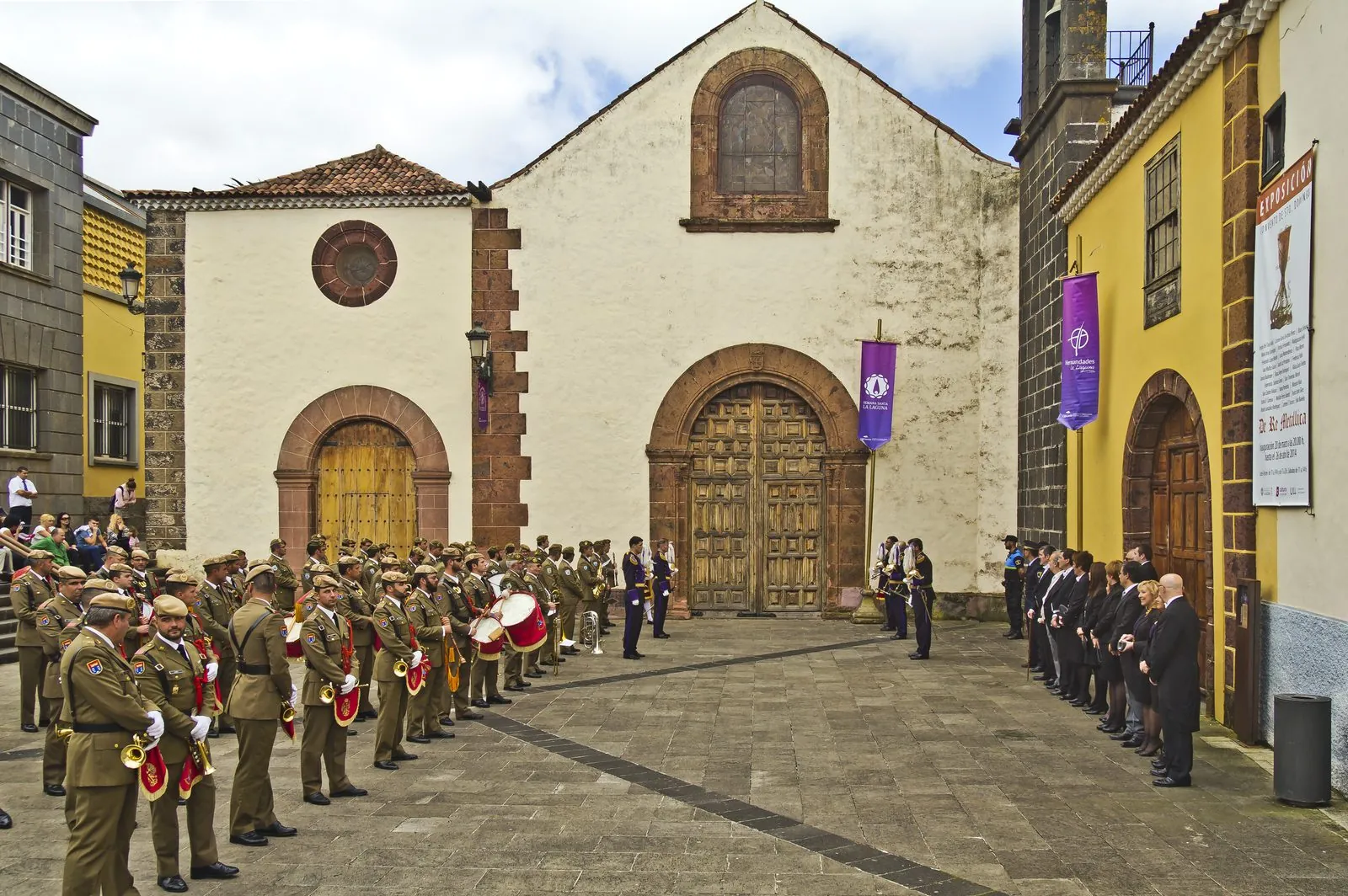
Photo: Koppchen · CC BY 3.0 · Wikimedia Commons · scaled
La Laguna — the finest on Tenerife
The historic university city of San Cristóbal de La Laguna on Tenerife, a UNESCO World Heritage town, is the island's spiritual home of Holy Week. Its perfectly preserved old streets, lined with grand churches and colonial mansions, make an incomparable stage for the processions. The most moving moment is the Procesión Magna on Good Friday, when the city's brotherhoods combine to carry a great sequence of pasos through the centre, and the silent night procession that draws hushed, candle-holding crowds. It is genuinely spine-tingling.
Las Palmas and the old towns
On Gran Canaria, the atmospheric Vegueta quarter of the capital hosts the island's most important processions, filing past the cathedral and through the oldest streets in the archipelago. Across the islands, historic towns each stage their own: Telde and Gáldar on Gran Canaria, and the northern Tenerife towns of La Orotava, Icod and Garachico, all keep the traditions with real devotion. Even small villages hold simple, heartfelt processions — sometimes the most memorable of all.
The rhythm of the week
Holy Week builds day by day towards Easter Sunday.
- Domingo de Ramos (Palm Sunday). The week opens with palm and olive branches blessed and carried through the streets.
- Jueves Santo (Maundy Thursday). Evening processions grow larger and more solemn, marking the Last Supper.
- Viernes Santo (Good Friday). The emotional peak — the great processions of the crucifixion, including La Laguna's Procesión Magna and many silent, candlelit night walks.
- Sábado Santo (Holy Saturday). A quieter day of vigil, with the Virgin's solitude marked in some towns.
- Domingo de Resurrección (Easter Sunday). The mood lifts into joyful celebration of the resurrection, sometimes with a symbolic encuentro where floats of Christ and the Virgin "meet".
| Day | What to look out for |
|---|---|
| Palm Sunday | Blessing and procession of palm branches |
| Maundy Thursday | Large evening processions; brotherhoods in robes |
| Good Friday | The grand and silent processions — the highlight |
| Holy Saturday | Vigil and quieter observances |
| Easter Sunday | Joyful resurrection celebrations |
Watching respectfully
Processions are religious acts, not tourist shows, and locals take them seriously — but visitors are entirely welcome to watch. A little sensitivity goes a long way: keep quiet and still as a paso passes, don't block the route or the brotherhoods, dress a touch more modestly than for the beach, and be discreet with cameras, especially during the silent processions. Give the penitents room and let the moment speak for itself.
Over the Easter long weekend, ferries, hire cars and popular restaurants book out and inter-island travel gets busy. If you're island-hopping around this time, reserve transport and beds well ahead.
Beyond the processions
Easter is also a food moment: look out for seasonal sweets in the bakeries, from torrijas (a Spanish take on French toast, soaked in milk or wine and fried) to island specialities. And because it falls in spring, the weather is usually kind — warm, bright days perfect for pairing an evening procession with a daytime hike or beach visit. The greener northern towns, where many of the best processions take place, are especially lovely at this time of year, with the hillsides at their most verdant before the summer dries them out.
It's worth remembering, too, that Semana Santa is one of the great travel weeks for Spaniards themselves, many of whom holiday on the islands over the break. That brings a lively, celebratory undercurrent to the solemnity — busy restaurants, full promenades and a real holiday buzz once each day's processions have passed. Book a table in the evenings, and you'll find the atmosphere in the old towns is as much about family and community as about religion.
Fitting it into your trip
Semana Santa offers a completely different window into island life from the summer beach scene — reflective, beautiful and steeped in history. It's one chapter in the islands' rich calendar, covered alongside everything else in our guide to festivals and carnival in the Canaries. Base yourself in or near La Laguna for the finest processions on Tenerife, check the local timetables when you arrive, and give yourself an evening to simply stand in an old plaza and watch a centuries-old tradition unfold.