Living in Gran Canaria means choosing between three quite different places on one round island: Las Palmas, the biggest city in the Canaries, with a beach in the middle of it; the dry, sunny resort coast of the south; and the green hill towns of the interior. All three are within an hour of each other on the GC-1 motorway and the mountain roads, but they suit different people, and most residents who are happy here chose their corner deliberately.
The city gives you a Spanish working life, a university, theatres and the island's best public transport, with grey summer mornings as the price. The south gives you sunshine almost every day, an international community and the highest rents in the archipelago. The interior gives you cooler air, village life and lower costs, as long as you have a car and some Spanish.
This page is about settling and everyday life rather than holidays; for hotels and holiday flats, our page on where to stay in Gran Canaria is the right one. The residency steps, from the NIE to health cover, are the same on every island and are set out in order in our hub on moving to the Canary Islands.
Las Palmas: a real city by the sea
Most of the foreigners who move to Las Palmas to work rather than retire end up in the strip between the port and the city beach, in Guanarteme, Santa Catalina and Alcaravaneras. The draw is obvious: Las Canteras, three kilometres of sand sheltered by a natural reef, where people swim before work, run along the promenade at lunchtime and watch the sunset after it. The city has a large university, the Universidad de Las Palmas de Gran Canaria, one of Spain's major ports, and the administrative offices of half the province, so the job market is broader than anywhere in the south.
Each district has its own character. Triana is the shopping street and the old merchants' quarter; Vegueta, the colonial old town, has the cathedral, the Columbus House and a covered food market dating from the nineteenth century; Ciudad Jardín, the "garden city", is a district of villas and gardens built in the English style for the port's merchant families; and up the hill, Tafira is greener, quieter and favoured by families. Asking rents in the city were around €15.90 per square metre per month in mid-2026, according to the Fotocasa index reported by Diario de Avisos, well below the southern resorts.
The trade-off is weather. From late spring to early autumn, low cloud often sits over the north-east of the island for much of the morning, which locals call the panza de burro, the donkey's belly. It is warm and bright enough for the beach most days, but anyone who moved for a suntan finds themselves driving south on summer weekends with half the city.
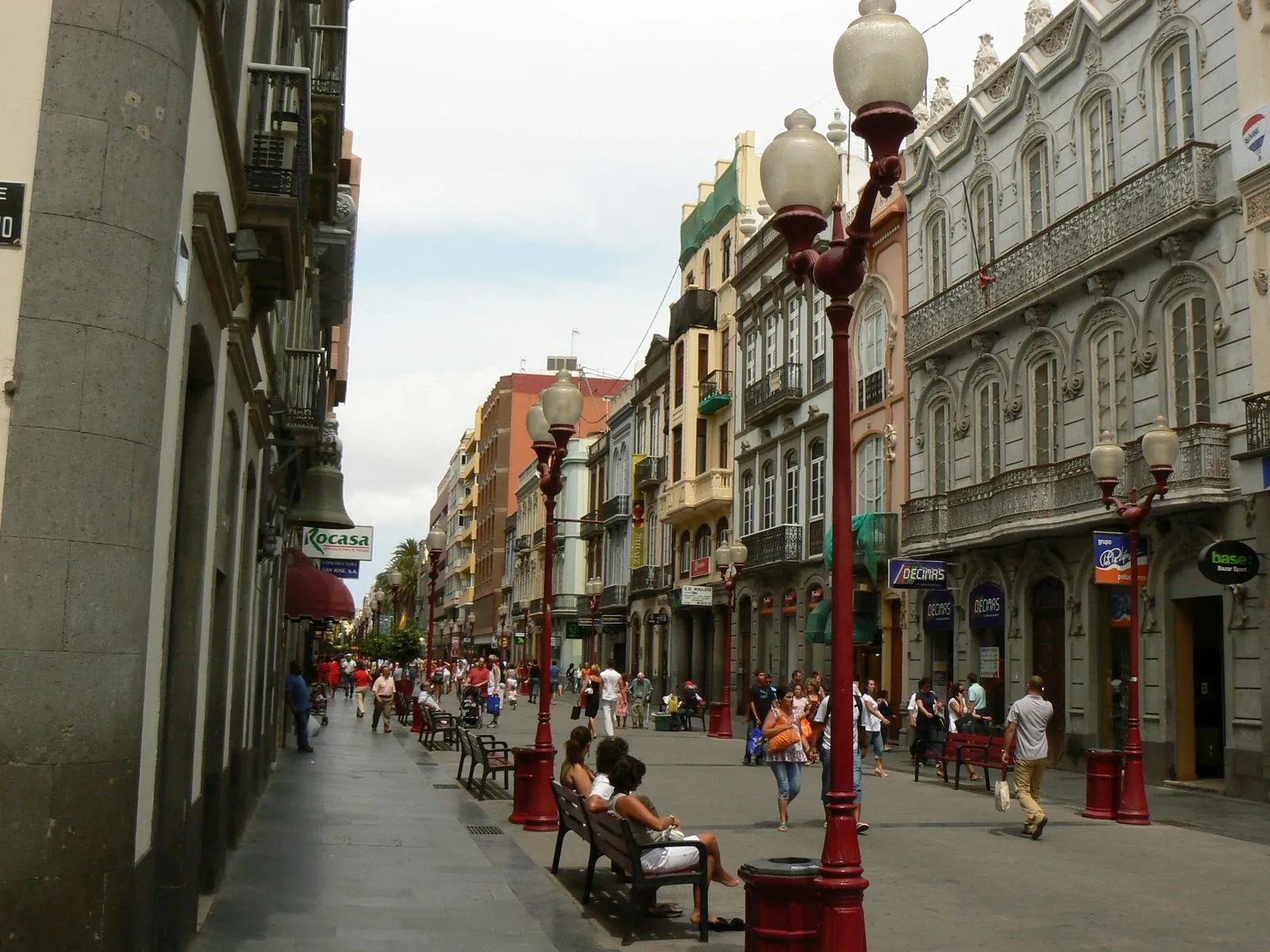
Photo: Sloggi · CC BY-SA 4.0 · Wikimedia Commons · scaled
The south: sunshine and the resort economy
The southern municipalities of San Bartolomé de Tirajana, which includes Maspalomas, Playa del Inglés and San Agustín, and Mogán, which includes Puerto Rico, Puerto de Mogán and Arguineguín, have the island's most reliable sunshine. They also have the most expensive rents in the whole archipelago. The same Fotocasa figures put Mogán at €21.55 and San Bartolomé de Tirajana at €21.49 per square metre per month in the second quarter of 2026, the two highest of any Canarian municipality, because so much of the housing stock is let to tourists.
Daily life here is shaped by tourism. Most jobs are in hotels, restaurants and services, with shift work and modest wages; the shops and services are geared to visitors, with English, German and the Scandinavian languages widely spoken; and the quieter residential areas, such as Sonnenland, El Tablero and the hills above San Fernando, are where people who work in the resorts actually live. Our page on renting long-term in the Canaries explains why year-round lets are so hard to find on this coast and how to avoid seasonal contracts dressed up as permanent ones.
Arguineguín and the Norwegian winter
The south has one foreign community that has shaped a town more than any other. Norwegians have been wintering in Arguineguín and the Mogán coast since the early days of package tourism, and the town has Norwegian-run businesses, a long-established Norwegian school and a seamen's church. RTVC reported in May 2023 that around a thousand Norwegians were on Mogán's register, but that the number rises to about eight thousand in autumn and winter, which makes the town feel very different in February from the way it feels in June.
The same report noted that, although Norway is not in the EU, Norwegian residents can vote in Spanish municipal elections under a bilateral agreement. British residents have a similar right: gov.uk's Living in Spain guidance says UK nationals can vote in local elections once they have been resident for three years and are on the electoral register. In municipalities like Mogán, where foreign residents make up a large share of the population, that is a real voice in how the town is run, and few newcomers use it.
The interior: hill towns and cooler air
Inland and uphill from Las Palmas, the towns of Santa Brígida, Vega de San Mateo, Valsequillo and Teror sit among eucalyptus, palms and terraced fields, a few hundred metres above the coast. They are noticeably cooler and wetter in winter, with fresh mornings and log fires in January, and they are Canarian towns where Spanish is the language of the street, the farmers' market and the town hall. Many residents commute to Las Palmas, twenty to forty minutes away depending on the town and the traffic.
Further out, Arucas, Firgas and Moya in the north, and Agüimes and Ingenio on the east side, offer older town centres and lower rents. Arucas and Santa Lucía de Tirajana were among the cheapest municipalities in the Fotocasa table, at around €10–12 per square metre per month. The high villages around Tejeda and Artenara are beautiful but remote, with winding roads, limited services and real cold on winter nights: lovely for a second home, demanding for a first.
Getting around the island
The GC-1 motorway runs down the east coast from Las Palmas past the airport at Gando to the southern resorts, and it is the island's main artery. Traffic into Las Palmas in the morning and out in the evening is heavy, and anyone commuting from the south should allow for it. The yellow Guaguas Municipales cover the city itself, and the blue Global buses link the towns and resorts, as our page on buses in Gran Canaria explains.
Residents have been able to travel free on certain multi-trip passes thanks to state funding for the islands' public transport. Diario de Avisos reported in October 2026 that the scheme was guaranteed until 31 December 2026, but that an extension into 2027 had not been confirmed, so check the operators' current conditions before counting on it. Outside the city, most households still need a car. gov.uk's Living in Spain guidance says a UK licence can be used for six months after you become resident and should be exchanged before that period ends.
Healthcare
Public healthcare is provided by the Servicio Canario de la Salud. As gov.uk's healthcare guidance for Spain explains, you register at your local health centre with your social security number once you are covered, whether through work, a UK-funded S1 as a state pensioner, or the paid convenio especial after a year on the padrón. Your GP is at the centro de salud for your address.
The island's two main public hospitals, the Hospital Universitario de Gran Canaria Doctor Negrín and the Complejo Hospitalario Universitario Insular-Materno Infantil, are both in Las Palmas. Southern residents travel up the GC-1 for specialist care, and many with private insurance use the private clinics in the resorts for routine visits. For prescriptions and minor problems, the local pharmacy is the first stop, as described on our page about pharmacies and medical care.
Schools, work and language
Young children usually do well in the local state school, where they are taught in Spanish under the Canarian curriculum and pick up the language within a year. Families with older children often look at the private international schools in and around Las Palmas and in the south, some of which teach the British curriculum. Fees vary a great deal; check that a school is recognised by the Spanish education authorities, and that British-curriculum schools are members of the National Association of British Schools in Spain, which inspects them.
Work is the island's weak point for newcomers. The city offers the widest range of jobs, but most require good Spanish, and wages across the Canaries are low by British standards. Remote workers have made Las Palmas one of the best-known bases in Europe for working online.
What daily life feels like
A working week in Las Palmas looks much like one in any Spanish city: offices open early, lunch is late, shops close in the afternoon in the older districts, and the evening paseo along Las Canteras is the city's social hour. Carnival in February takes over the streets for weeks. In the interior, life follows the farming year and the fiestas, the biggest being the Virgen del Pino in Teror each September, when the whole island seems to walk there. In the south, the rhythm is set by the tourist seasons, busy in winter and quieter, though rarely empty, in late spring.
Paperwork is done through cita previa, the online appointment system, and patience and a good gestor help. The calima, Saharan dust that hazes the sky, blows in several times a year and passes. And Spanish, even basic Spanish, changes the island from a place you live in to a place you belong to. For a sense of what all this costs, our page on the cost of living in the Canaries sets out a resident's budget, and our page on retiring to the Canaries covers pensions and the S1.
Finding your corner of Gran Canaria
Choose Las Palmas if you want a city, work, culture and a beach on your doorstep, and can live with grey summer mornings. Choose the south if sunshine comes first and you can afford the rents, or plan to winter here as the Norwegians do. Choose the interior towns around Santa Brígida, San Mateo and Teror if you want cooler air, lower costs and Spanish village life within reach of the city. Rent first, spend a summer and a winter, and you will know which of the three islands within Gran Canaria is yours.