For a few days each summer, the streets of one Tenerife town are transformed into a vast open-air gallery — carpeted with flowers, petals and coloured volcanic sand in pictures so intricate they stop you in your tracks. The Corpus Christi alfombras of La Orotava are among the most extraordinary folk artworks in Spain: enormous, painstakingly detailed "carpets" laid directly onto the cobbles, built over days by hundreds of hands, and destined to survive only until a religious procession walks straight over them. It's an act of devotion, community pride and sheer artistic ambition rolled into one — and one of the great sights of the Canarian year.
Here's the story of the flower carpets — how they're made, where to see the best of them, and when this magical, fleeting tradition usually takes place.
Corpus Christi is a movable feast tied to Easter, so it shifts each year — usually falling in June, occasionally late May. Dates and the exact procession day vary, so confirm locally before planning a trip around it.
What Corpus Christi is
Corpus Christi is a Catholic feast celebrating the Eucharist, held some weeks after Easter. Across the Spanish-speaking world it's traditionally marked by street processions, and in a handful of places by the laying of decorative carpets along the route for the sacrament to pass over. In the Canaries, the town of La Orotava in the lush Orotava Valley on Tenerife has turned this custom into something spectacular — a tradition stretching back well over a century and a half, and a genuine point of island identity.
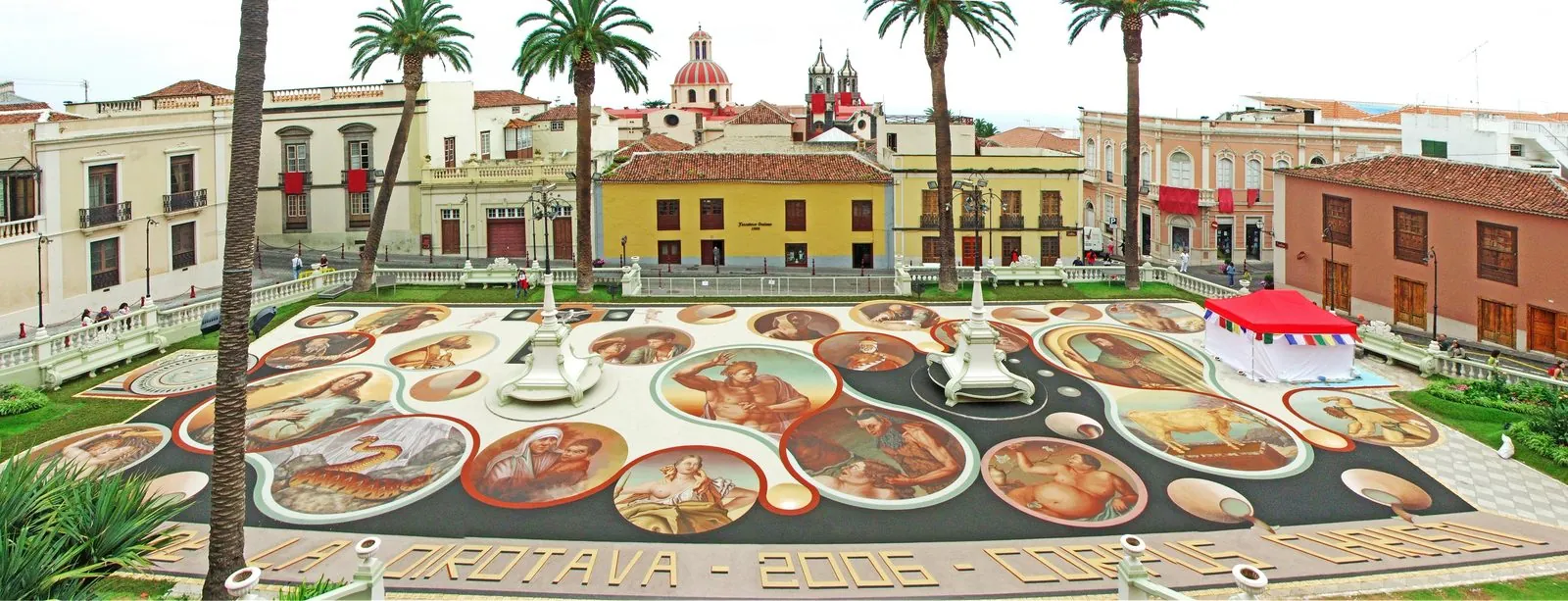
Photo: Koppchen · CC BY 3.0 · Wikimedia Commons · scaled
The great tapiz of the town hall square
The undisputed masterpiece is the enormous tapiz laid in front of the town hall in the Plaza del Ayuntamiento. Unlike the flower carpets in the surrounding streets, this giant tableau is made almost entirely from coloured volcanic earth and sand — natural pigments gathered from around the island and from the slopes of Las Cañadas del Teide. A single family, the Machado dynasty, has traditionally overseen its creation for generations, and each year the huge design depicts a fresh religious or artistic scene in astonishing, painting-like detail. It regularly claims a place among the largest works of its kind anywhere.
Come in the day or two before the procession to watch the carpets being built — arguably more rewarding than seeing the finished article. You can see the artists at work, the sand and petals being sifted into place grain by grain, and the pictures slowly emerge.
How the carpets are made
The flower carpets that line the surrounding streets are a community effort, with families and neighbourhood associations each taking a stretch of road. The process is slow, meticulous and quietly astonishing:
- The design is drawn out. Outlines are chalked or stencilled onto the street to map the picture — often religious motifs, but also geometric borders, landscapes and elaborate ornamental patterns.
- Materials are gathered. Fresh flower petals, leaves, seeds, salt and different shades of natural volcanic sand are sorted by colour, sometimes for weeks beforehand.
- The picture is filled in. Working on their knees, makers press and sprinkle the materials into the outlines, blending colours to create shading and depth. Flowers are kept fresh and laid at the last minute so they're at their brightest for the procession.
- Then it's gone. On the feast day the religious procession walks the length of the carpets, and hours of collective effort are scattered underfoot — a deliberate, moving symbol of impermanence and offering.
La Laguna and beyond
La Orotava may be the most famous, but it isn't alone. The historic city of La Laguna also lays beautiful Corpus Christi carpets through its old streets, and other Tenerife towns — including nearby villages of the north — keep the tradition alive. On other islands, smaller flower-carpet displays appear too. If your dates don't quite line up with La Orotava's procession, it's well worth asking locally what's happening elsewhere that week.
| Where | What makes it special |
|---|---|
| La Orotava (Plaza del Ayuntamiento) | The giant volcanic-sand tapiz — the showpiece |
| La Orotava streets | Community-made flower and petal carpets along the route |
| La Laguna | Flower carpets through the UNESCO old town |
| Other northern towns | Smaller local carpets and processions |
The origins of the tradition
La Orotava's carpets trace back to the mid-19th century, when — so the story goes — a local family began decorating the street outside their home for the Corpus procession with flower petals, and the idea caught on and grew ever more ambitious. Over generations it evolved from simple floral borders into the vast, painting-like tableaux you see today, and the skills have been handed down within Orotava families ever since. It's become a matter of deep civic pride, drawing thousands of spectators and photographers each year and earning the town a place among Spain's most celebrated Corpus celebrations. The know-how — which flowers hold their colour, how to grade the volcanic sands, how to shade a face in petals — is genuine folk artistry, learned by doing.
Planning your visit
La Orotava is an easy day trip from the northern resorts and from Puerto de la Cruz, and even without the carpets it's one of Tenerife's prettiest towns, full of carved wooden balconies and grand old mansions — reason enough to visit any time, as our guide to La Orotava explains. On Corpus Christi it's busy, so arrive early, wear comfortable shoes, and be ready for street closures. Parking is limited; consider the bus or arriving well ahead of the crowds.
Do not step on the carpets — it should go without saying, but they are fragile and represent enormous effort. Keep to the marked viewing areas, watch children closely, and photograph from the edges.
A fleeting masterpiece
There's something profound about spending days creating a work of breathtaking beauty knowing it will be swept away within hours. That, more than anything, is what makes the Corpus Christi carpets so special — art made not to last but to be given. It sits among the very finest of the island celebrations gathered in our guide to festivals and carnival in the Canaries. Time your Tenerife trip to catch it, and you'll witness something you'll never forget — even though, by the next morning, it's already gone.