Christmas in the Canary Islands comes with a twist that never stops delighting first-time visitors: you can watch a nativity scene one moment and swim in a warm sea the next. With daytime temperatures often in the low twenties, the festive season here is a gentle, sunlit affair — long on tradition and family warmth, short on snow and slush. Twinkling lights drape palm-lined plazas, hand-built nativity scenes appear in every town, choirs sing in the squares, and the whole thing builds not to Christmas Day but to Epiphany on 6 January. For anyone escaping a grey northern winter, it's one of the loveliest times to be on the islands.
Here's how Canarians celebrate the festive weeks — the belenes, the lights, the Christmas sea swims, the grape-gobbling New Year's Eve and the fireworks — plus what the weather's really like.
Belenes — the nativity scenes
The centrepiece of a Canarian Christmas isn't the tree but the belén, the nativity scene. These range from small home displays to vast, astonishingly detailed public installations that fill entire halls or plazas, complete with miniature villages, running water, working windmills and hundreds of hand-painted figures. Town halls, churches and shopping centres compete to outdo one another, and touring the best of them is a beloved local pastime. Look out too for the belén viviente — a living nativity in which villagers act out the scene in period costume with real animals. It's a genuinely magical thing to stumble upon.
Ask at any tourist office for a list of the year's notable belenes. The sand nativity sometimes built on the beach at Las Canteras in Las Palmas, and the big displays in historic town centres, are especially worth seeking out.
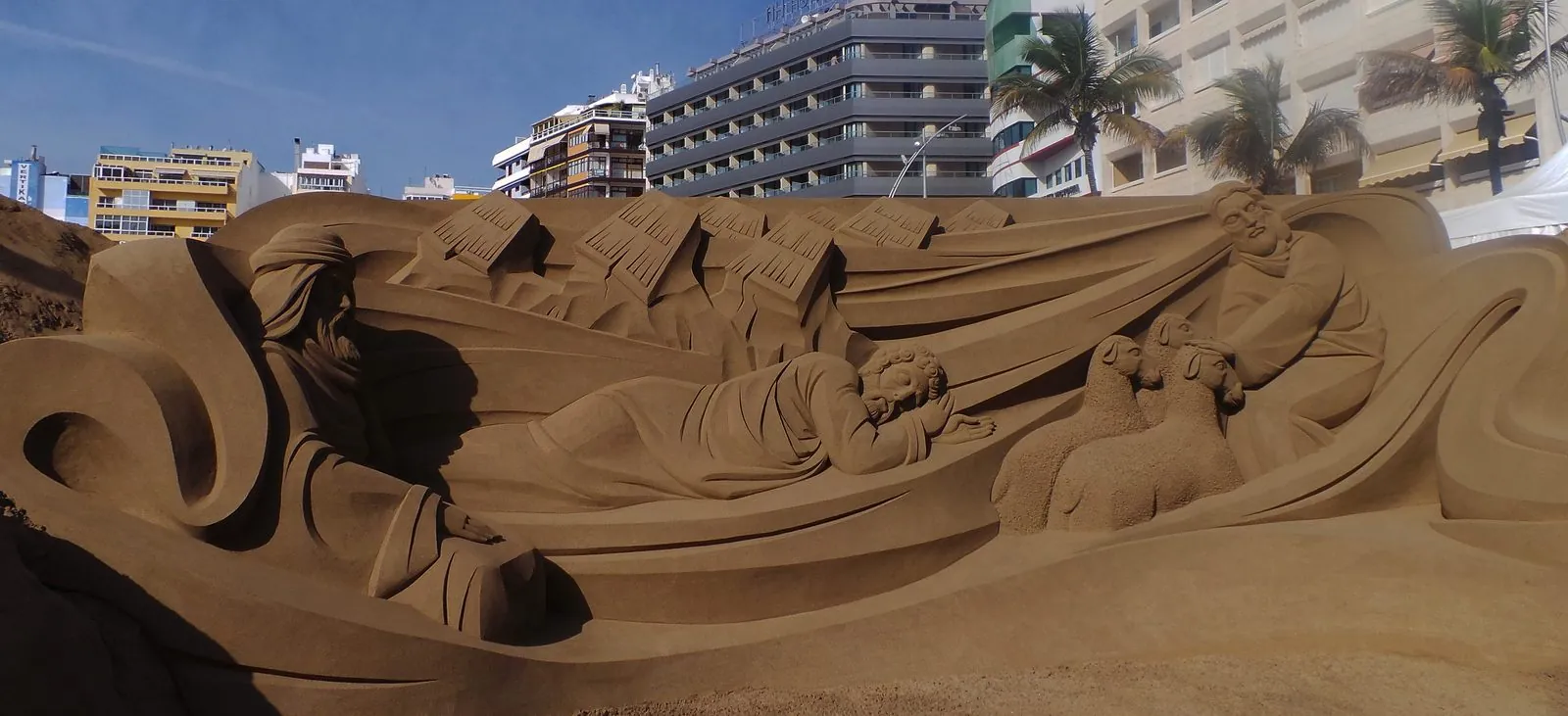
Photo: El Coleccionista de Instantes Fotografia y Video · CC BY-SA 2.0 · Wikimedia Commons · scaled
Lights, markets and music
From early December, town centres switch on their Christmas lights and the plazas fill with market stalls selling crafts, sweets and seasonal treats. Choirs and folk groups perform villancicos (carols), often to the tinkle of the timple, the little Canarian guitar. The atmosphere is relaxed and family-focused rather than commercial — you can wander in shirtsleeves, buy roasted chestnuts, and enjoy the glow without the northern-hemisphere chill. The historic quarters of the island capitals are especially atmospheric after dark.
Christmas Day, Canarian style
The main family meal traditionally falls on Nochebuena, Christmas Eve, rather than Christmas Day. Households gather for a long, generous dinner, and many attend the Misa del Gallo (Midnight Mass). Christmas Day itself is quieter and more relaxed. Historically, children didn't receive their main presents now at all — that honour belongs to the Three Kings in January — though the figure of Santa (Papá Noel) has become more common in recent years.
The Christmas swim
One of the season's happiest quirks is the Christmas sea swim. On mild December mornings, locals and visitors alike take to the water — some towns organise a festive group dip, occasionally with Santa hats and fancy dress. With sea temperatures still pleasant and the sun out, a Christmas-morning swim followed by a coffee on the promenade is about as far from a snowy Christmas as you can get, and all the more memorable for it.
Nochevieja — New Year's Eve
New Year's Eve, Nochevieja, is celebrated with the whole of Spain's most famous ritual: the twelve grapes. As the clock strikes midnight, everyone tries to eat one grape on each of the twelve chimes — one for luck in each month of the coming year. It's harder (and funnier) than it sounds, and cheeks are soon comically full. Families follow it with cava, sweets and dancing, and many towns throw a big open-air party in the main square with live music running into the small hours.
The twelve-grapes tradition really does catch people out — pop them in your mouth quickly and don't try to chew each one fully, or you'll never keep up with the chimes. Deseeded, easy-peel grapes make it far simpler.
Fireworks over the bays
Come midnight, fireworks light up the seafronts of the island capitals and larger resorts, reflected in the calm Atlantic. The displays over the harbours of Santa Cruz and Las Palmas, and along the resort bays of the south, draw big, good-natured crowds. Dress is light — a jumper is often all you need — and the mild night air makes an outdoor New Year here a real pleasure. Bars and clubs then pick up the party until dawn.
Weather to expect
December and early January are among the "coolest" months, but by northern standards they're gloriously mild. Expect daytime highs typically in the low twenties Celsius on the sunnier southern coasts, cooler and greener in the north, and chilly evenings that call for a light jacket. Rain is more likely than in summer, especially in the north, and the mountains — including Mount Teide — can see snow, a surreal sight above the palm-fringed coast. The sea stays swimmable for the hardy. That mild, reliable warmth is exactly why the islands are Europe's favourite winter-sun escape. For the full monthly picture, see our guide to the Canary Islands in December.
| Date | What happens |
|---|---|
| Early December | Lights switch on; belenes and markets appear |
| 24 December (Nochebuena) | Main family dinner; Midnight Mass |
| 25 December | Relaxed Christmas Day; Christmas swims |
| 31 December (Nochevieja) | Twelve grapes, cava, fireworks and street parties |
| 5–6 January | Three Kings parades and gift-giving |
The grand finale — Three Kings
The festive season doesn't end on New Year's Day. Its true climax is Reyes, the feast of the Three Kings on 6 January, when the Magi — not Santa — bring children their presents. On the evening of the 5th, dazzling Cabalgata parades wind through towns across the islands, with the Kings tossing sweets to the crowds from elaborate floats. It's the emotional high point of Canarian Christmas; we've given it its own guide to Three Kings Day.
Planning a festive escape
A Canarian Christmas is warm in every sense, and the season slots neatly into the islands' wider calendar of festivals and celebrations. Book flights and accommodation early — this is peak winter-sun season and the islands are popular over the holidays. Come for the mild days and family warmth, stay for the grapes and the fireworks, and don't leave before the Kings ride into town.