For a winter beach break, the Canary Islands are the easier and warmer choice; for a city of souks, riads and mosques, Morocco offers something the islands simply do not have. Agadir, Morocco's main beach resort, has almost exactly the same January daytime high as southern Tenerife, but its nights are around 7°C colder, its sea is open Atlantic surf, and the practicalities of a trip are a little more involved: a closed currency, stricter rules on alcohol and dress, and a clock that jumps around Ramadan. Marrakech is a different proposition altogether, and the reason many people look at Morocco in the first place.
The two are close neighbours. Fuerteventura lies only around 100 km off the Moroccan coast, and the whole archipelago sits on roughly the same latitudes as southern Morocco, which is why the daytime weather looks so similar on paper. What changes when you cross that stretch of sea is everything else: the islands are part of Spain and the EU, with euros, Spanish law and supermarkets that would not look out of place in Málaga, while Morocco is a North African kingdom with its own language, religion, currency and customs.
This page puts the two side by side for a British or Irish traveller: the weather month by month from each country's national met service, flights and time, money, local norms, what the UK government says about safety, and finally who should book which. The climate figures are long-term averages and should be read as typical; any given week can differ.
Same latitude, different nights
The Canaries are islands surrounded by a large, cool ocean, and that ocean barely changes temperature from day to night. It acts like a storage heater: in winter the air over the southern coasts of Tenerife and Gran Canaria rarely falls much below 15°C after dark. Agadir is on a continental coastline, with the Anti-Atlas and the Sahara at its back. Under clear winter skies the land loses its warmth quickly at night, and the mornings are distinctly fresh.
That is the single most useful number on this page. Morocco's national weather service, the Direction de la Météorologie Nationale, gives Agadir an average January maximum of about 21°C, almost identical to AEMET's figure of about 22°C for Tenerife South airport. The January minimum, though, is about 8°C in Agadir against about 15°C in southern Tenerife. In practice that means a warm afternoon on the beach in both places, but a jumper and long trousers for dinner in Agadir, and a terrace meal in a T-shirt on the islands. The mechanism is explained on our page about the Canary Current and the climate.
Marrakech, well inland on the plain below the High Atlas, takes the continental effect further. Its winter days are pleasantly mild, but January nights average under 6°C, and the snow on the High Atlas is often visible from the city. Riads, the traditional courtyard houses that most visitors stay in, are built to keep cool in summer, and many feel chilly in January, so ask about heating before you book.
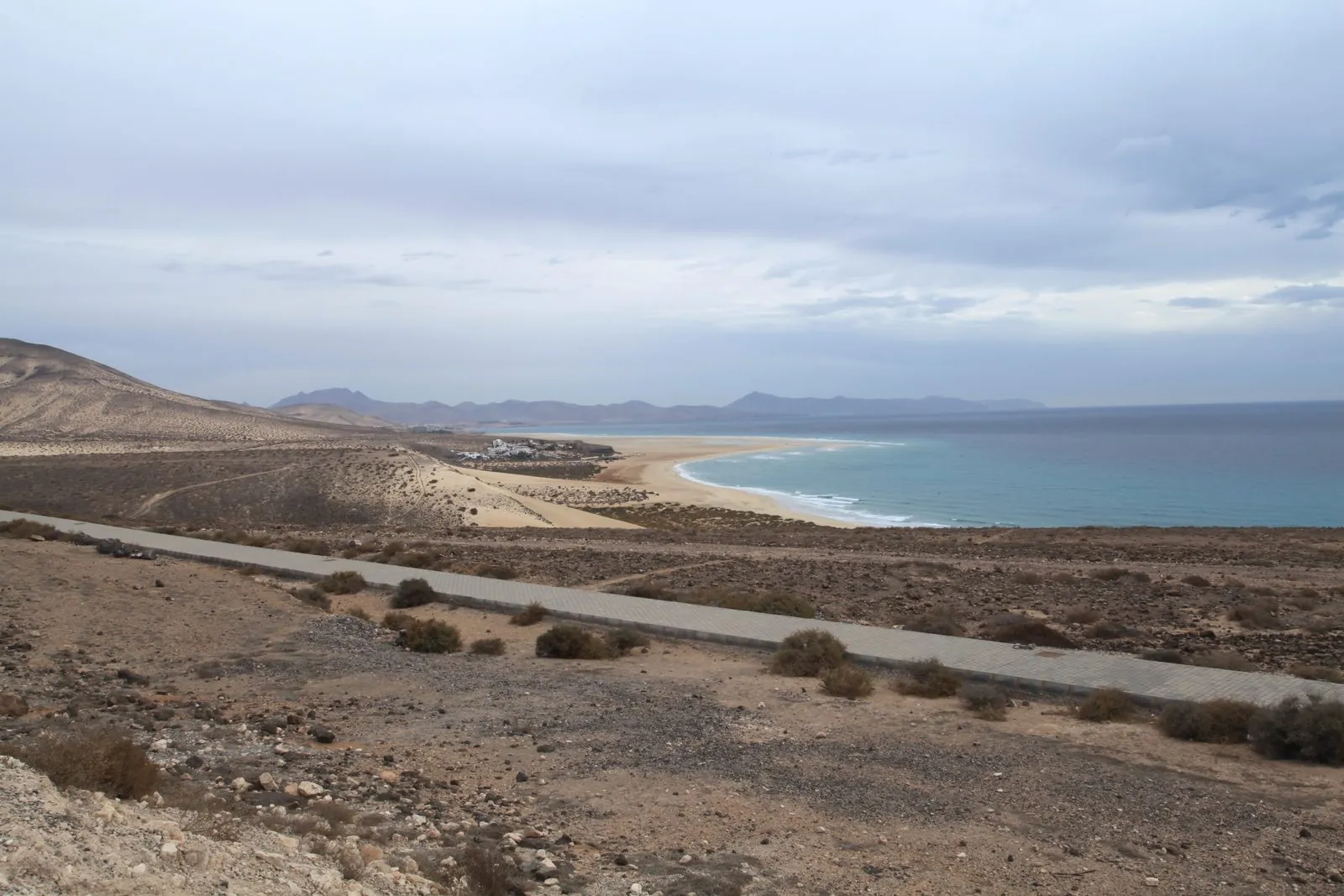
Photo: Frank Vincentz · CC BY-SA 3.0 · Wikimedia Commons · scaled
Agadir, Marrakech and southern Tenerife through the year
The table uses the national services' normals: 1991–2020 for Agadir Inezgane and Marrakech from the Direction de la Météorologie Nationale, and 1981–2010 for Tenerife South airport from AEMET, Spain's state weather agency. Tenerife South is a fair stand-in for the main southern resorts of the Canaries.
| Month | Tenerife South: day / night | Agadir: day / night | Marrakech: day / night |
|---|---|---|---|
| January | 22°C / 15°C | 21°C / 8°C | 19°C / 6°C |
| March | 23°C / 16°C | 23°C / 12°C | 24°C / 10°C |
| May | 24°C / 17°C | 24°C / 16°C | 29°C / 15°C |
| July | 28°C / 20°C | 27°C / 19°C | 38°C / 21°C |
| October | 27°C / 20°C | 26°C / 17°C | 29°C / 16°C |
| December | 23°C / 17°C | 22°C / 10°C | 20°C / 7°C |
Two patterns stand out. In summer Agadir and the Canaries are almost twins, both cooled by the same ocean and the same northerly winds, while Marrakech becomes a furnace with July afternoons near 38°C. In winter the daytime figures converge again, but the nights split apart. Rain is modest in both: Agadir's wettest months are November to January, with around 30–47 mm a month, which is more than southern Tenerife gets but still a dry climate by British standards. Both coasts also see the occasional Saharan dust haze, known in the islands as the calima.
The beach: Agadir's bay against the island resorts
Agadir has one long, wide crescent of sand, several kilometres of it, backed by a promenade and a strip of hotels. It is a good beach for walking and for families who want space, and the bay is more sheltered than most of Morocco's Atlantic coast. Even so, this is the open ocean, and the UK government's Morocco advice notes that many beaches have little or no lifeguard cover and that strong currents and unexpected waves occur. Treat the water as you would on an exposed Atlantic beach, not a lagoon.
The Canaries give you far more choice of beach. There are the dunes at Maspalomas, the long golden beaches of Fuerteventura, small black-sand coves and man-made, breakwater-protected beaches in the big Tenerife resorts where children can paddle in calm water. If surfing is the point of the trip, the comparison is closer: the villages just north of Agadir, Taghazout in particular, are among the best-known surf spots in North Africa, and the islands have their own strong scene, covered on our page about surfing in the Canaries.
One historical detail explains why Agadir feels so different from older Moroccan cities. On 29 February 1960 an earthquake destroyed most of the town and killed well over 10,000 people. The city was rebuilt from scratch a little to the south, which is why today's Agadir is a modern grid of low-rise blocks rather than a walled medina. The ruined kasbah on the hill above the port, Agadir Oufella, is what remains of the old town, and the Arabic words for "God, Country, King" are spelled out in huge letters on the hillside below it.
Marrakech: the trip the islands cannot match
Most people who choose Morocco over the Canaries are choosing Marrakech, not a beach. The medina, the Jemaa el-Fnaa square at dusk, the souks, the palaces and the gardens offer a sense of being somewhere genuinely foreign within four hours of home, and that is not something any Canary island can offer. The islands have handsome old towns, such as Vegueta in Las Palmas and the colonial grid of La Laguna, but they are Spanish towns, calm and familiar.
The flip side is intensity. The UK government notes that fake guides harass visitors in medina areas and advises checking for an official badge, and haggling is part of almost every purchase. Some visitors love the energy; others find three days is plenty. A popular compromise is a few nights in Marrakech followed by a week on the coast, either in Agadir or Essaouira, or by flying on to the islands.
Flights, clocks and the Ramadan switch
Flight times from the UK are similar. From London a direct flight to Marrakech typically takes around three and a half hours and to Agadir around four, while the main Canary airports are typically four to four and a half hours away. From Manchester, Glasgow or Dublin add a little to all of them. The islands have many more routes and far more winter frequency, because they are the UK's biggest winter-sun market.
The clock is where Morocco has a quirk most comparison guides miss. The Canaries keep UK time all year, as our page on the islands' time zone explains. Morocco keeps GMT+1 for most of the year, which makes it one hour ahead of the UK in winter and level with it in summer, but it switches back to GMT for the month of Ramadan. In 2027 Ramadan is expected to begin around 8 February, depending on the sighting of the moon, so a February half-term trip may find Morocco on UK time for part of the stay. Check the exact dates before you plan airport transfers.
Both drive on the right. The Canaries use the standard European two-pin plug, and Morocco uses the same two-pin types, so one adapter covers both.
Money: a currency you cannot buy before you go
The islands use the euro, and card payment is accepted almost everywhere. Morocco uses the dirham, which the UK government describes as a closed, non-convertible currency: it generally cannot be bought or exchanged outside the country. You arrive with euros, pounds or a bank card and get dirhams at the airport, at a bank or from a cash machine, and you spend or change back what you have before you leave. Foreign currency worth 100,000 dirham or more has to be declared on arrival and departure. Cash matters more in Morocco than in the Canaries, particularly in the souks, taxis and small cafés.
On price, Morocco is usually cheaper on the ground: a meal in a local restaurant, a taxi across town or a hammam costs noticeably less than its equivalent on the islands. Package holidays and flights narrow the gap, and the Canaries benefit from their own low sales tax, IGIC, which keeps drinks and fuel relatively cheap. Our page on what things cost in the Canaries gives typical ranges. Compare the same week in both before assuming either is the bargain.
Alcohol, dress and the rhythm of a Muslim country
This is the biggest everyday difference. In the Canaries you can buy wine in a supermarket, drink a beer on a beach-bar terrace and wear what you like on the promenade. In Morocco alcohol is sold in licensed hotels, restaurants and bars, and the UK government's advice is blunt that drinking anywhere else, including in the street, is illegal and can lead to arrest. Resort hotels in Agadir serve alcohol freely; a medina café will not.
Dress follows the same pattern. Swimwear is normal at hotel pools and on Agadir's beach, but away from them the UK government advises visitors, and women especially, to wear loose clothing covering the arms, legs and chest. During Ramadan, eating, drinking or smoking in public during daylight can offend, and some restaurants change their hours. Same-sex sexual relations are illegal in Morocco, according to the same advice, which matters to LGBTQ+ travellers; the Canaries, by contrast, are one of Europe's most relaxed destinations, as our LGBTQ+ guide to the islands describes.
Do not drink your welcome beer on the beach. Coming from the Canaries, where a can on the sand is unremarkable, it is easy to carry the habit across. In Morocco, alcohol belongs inside licensed premises and the hotel grounds, and nowhere else.
Entry rules and the UK's travel advice
British passport holders can visit Morocco without a visa for up to 90 days as tourists. The UK government says your passport must be valid for at least three months after the date you arrive, and recommends asking for an entry stamp, because some travellers have had trouble leaving without one. For the islands, which are in the Schengen area, the rules are set out on our page about entry requirements for the Canaries.
On safety, read the Foreign, Commonwealth and Development Office's Morocco travel advice on gov.uk before you book; it was last updated on 19 August 2026 and was still current in November 2026. In its safety section it states that terrorists are likely to try to carry out attacks in Morocco, and it covers petty crime, scams, demonstrations and swimming risks. We do not give our own verdict: the official advice and your insurer's terms are what count. The FCDO also publishes advice for Spain, which covers the Canary Islands.
Combining the two on one trip
Because they are so close, some travellers do both. There is no practical way to make it a day trip, but the Canary airline Binter has in recent years flown from Gran Canaria, and at times Tenerife, to Agadir and Marrakech, among other Moroccan cities. Schedules change from season to season, so check what is running for your dates. Remember that it counts as leaving the EU: passport checks, a different currency and, on return, the Schengen entry checks again.
Who should book which
Book the Canaries if you want a relaxed week of warm afternoons and warm evenings, easy family logistics, a choice of beaches and walks across several islands, and none of the friction of a different currency or culture. For a midwinter break in particular, the island nights make the difference; our page on winter sun in the Canaries shows where to aim.
Choose Morocco if the culture is the point: Marrakech for a long weekend of souks and riads, perhaps with Agadir or Essaouira attached, or Taghazout for a surf trip on a budget. Families with small children, travellers who like a drink by the beach and LGBTQ+ couples will usually find the islands easier. Adventurous couples and repeat visitors who know the Canaries well will find Morocco a fascinating contrast, just a short flight further south. If you are weighing up other long-haul-lite winter options, our comparison of the Canaries and Egypt's Red Sea looks at the warmest of them.