Between 1402 and 1496, the Canary Islands were slowly, brutally brought under the crown of Castile — not in one campaign but island by island, over almost a century of raids, alliances, betrayals and pitched battles. It began with a Norman adventurer landing on quiet Lanzarote and ended with the last free kingdom on Tenerife falling to Spanish arms. In between lies one of the most drawn-out conquests in European history, and the tragic story of how the islands' aboriginal Guanches lost their world.
Why did it take so long to subdue a handful of small Atlantic islands? Partly geography — each island had to be taken separately, across open sea — and partly the fierce resistance of peoples who knew every ravine and cliff. This is how it unfolded.
1402: Béthencourt lands on Lanzarote
The conquest proper opened in 1402, when the Norman lord Jean de Béthencourt and his companion Gadifer de la Salle sailed south under the flag of Castile. They came ashore on Lanzarote, the easternmost and most exposed island, whose people had already been worn down by decades of slave-raiding. Resistance was limited, and the newcomers built a base — the beginnings of the fortified presence that would one day include the castles of Arrecife.
From Lanzarote the invaders turned to neighbouring Fuerteventura. It proved harder: the island's two chiefdoms held out for several years before submitting around 1405. These early conquests were relatively quick because both islands are low, dry and comparatively easy to cross — and because their populations had already been depleted. Béthencourt returned to Europe styling himself "King of the Canary Islands", though in truth he held only the eastern fringe.
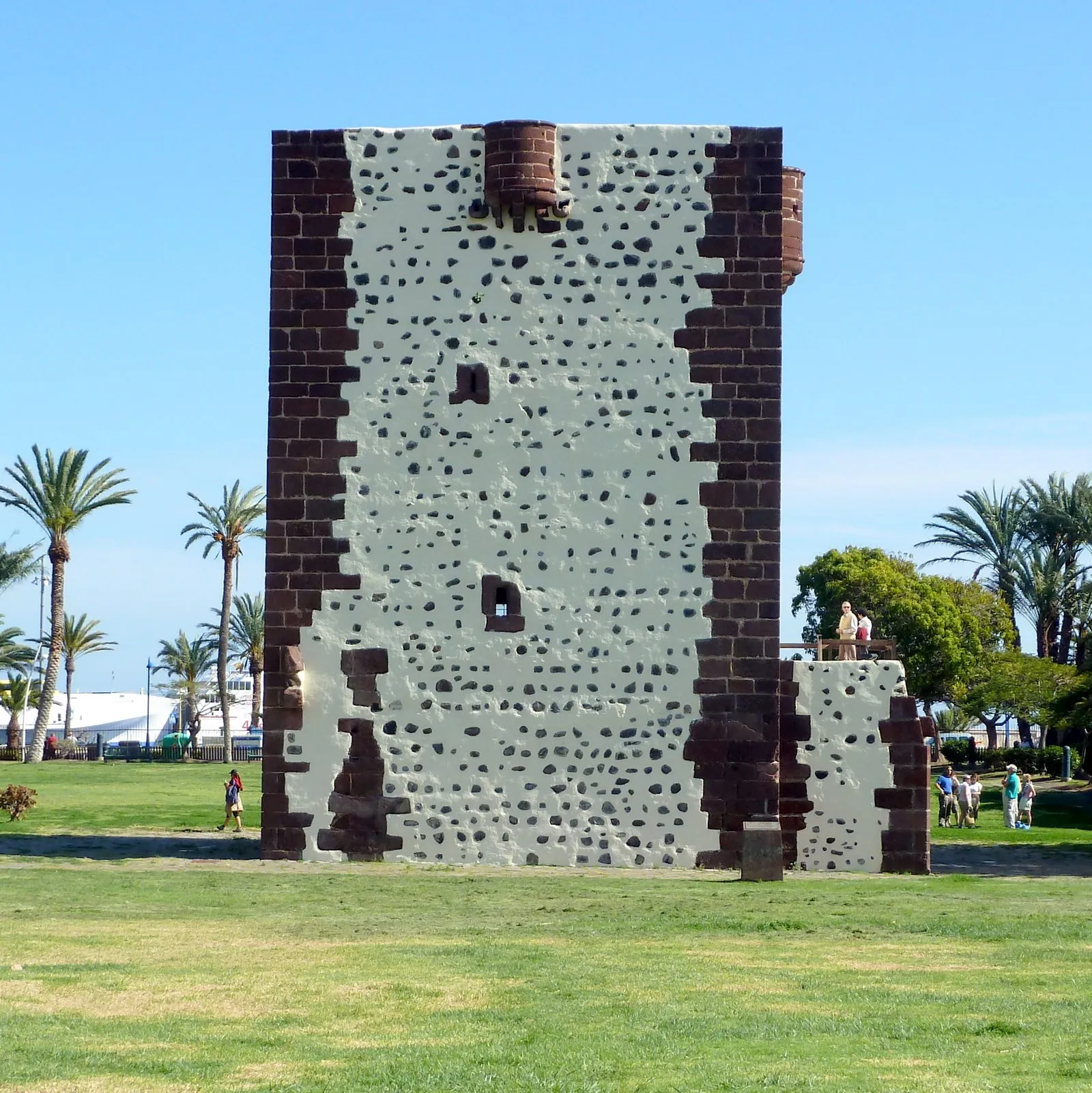
Photo: Николай Максимович · CC BY 3.0 · Wikimedia Commons · scaled
The "lordship" islands: El Hierro and La Gomera
El Hierro, the smallest and most remote island, fell early and with little bloodshed — helped, the chronicles say, by trickery and by the seizing of islanders as slaves. La Gomera was different. Rather than a single decisive conquest, it came under Castilian control gradually through the 15th century, its people never fully broken by open battle.
That uneasy arrangement turned violent in 1488, when the Gomerans rose against the cruelty of their overlord Hernán Peraza the Younger and killed him. The revolt was crushed with terrible severity from the island's stronghold, the Torre del Conde in San Sebastián de La Gomera — a squat, sand-coloured tower that still stands and is one of the oldest military buildings in the archipelago. Béthencourt's early campaigns and the later Peraza lordships made these the so-called "islands of the lords" (islas de señorío), held privately rather than directly by the crown.
The Torre del Conde in San Sebastián is free to admire from the pretty garden square around it, and its story — including Beatriz de Bobadilla, the widow who held it — is a vivid way into the conquest for anyone island-hopping to La Gomera.
The hard fight for Gran Canaria
The three western "crown islands" (islas de realengo) were another matter entirely. Larger, greener and far more populous, they were conquered directly by the Castilian crown after 1478 — and they fought.
Gran Canaria's conquest dragged on from 1478 to 1483. The islanders, led by their guanartemes, retreated into the mountainous interior around Tejeda and Ansite and resisted for five years. It ended not only through force but through the surrender of the aristocracy and the conversion of leaders such as Tenesor Semidán, baptised as Fernando Guanarteme, who then helped the Spanish subdue the rest. The final holdouts are traditionally remembered as leaping to their deaths from the crags rather than submit — a legend of defiance the island still cherishes.
La Palma and the trap at Acero
La Palma fell next, in 1492–93, in a swift campaign led by Alonso Fernández de Lugo. Most local chiefs came to terms quickly, but the last resistance held out in the vast crater at the island's heart — the Caldera de Taburiente, then called Acero — under the chief Tanausú. He was defeated not in fair battle but by a ruse: lured out under a promise of parley, he was ambushed and captured. He is said to have starved himself to death on the ship carrying him to Spain, refusing food in captivity.
1496: the last stand on Tenerife
Tenerife, the biggest and most heavily populated island, was the final prize — and the toughest. Divided into nine rival menceyatos, it did not fall easily. In 1494, at the First Battle of Acentejo, the invaders under de Lugo walked into a devastating ambush in a steep ravine and were massacred; the place is still called La Matanza ("the slaughter"). It was one of the worst defeats Castile suffered anywhere in its Atlantic expansion.
De Lugo regrouped, returned with reinforcements, and in 1495 won a decisive victory at the Second Battle of Acentejo, near modern La Victoria. By 1496 the exhausted menceyes — weakened as much by a mysterious epidemic, the modorra, as by the sword — submitted. The chief Bencomo's people were broken, and with Tenerife's fall the conquest of the whole archipelago was complete, almost a century after it began. To understand how this fits the longer story, see our short history of the Canary Islands.
The fate of the Guanches
Conquest was catastrophic for the aboriginal islanders. Many died in battle or from imported diseases to which they had no resistance; many more were enslaved and shipped to markets in Spain and beyond, even before the fighting formally ended. Those who remained were pressured to convert to Christianity, take Castilian names, and abandon their language and customs.
Yet they were never entirely erased. Chiefs who allied with or submitted to the crown often kept land and status, survivors intermarried with settlers, and their bloodline runs strongly through today's Tenerife and Canarian population. Their words, place names and traditions endure across the islands — a living undercurrent beneath the modern resorts.
It's worth remembering, as you enjoy the beaches and volcanoes, that this was a colonial conquest with real human cost. The islands' aboriginal heritage is a source of genuine pride locally — treat archaeological sites and museums with the respect that history deserves.
Seeing the conquest today
You can trace the whole saga on the ground. Battle sites on Tenerife are marked by the towns named after them — La Matanza and La Victoria — while the Torre del Conde on La Gomera and the early forts of Lanzarote and Gran Canaria carry the story in stone. Pair a museum visit with a drive through the mountainous interiors where the last islanders held out, and the conquest stops being a date in a book. It becomes the reason the Canaries look, speak and feel the way they do.