If you've spent time in Latin America, the Spanish of the Canary Islands will sound oddly familiar — soft, quick, warm and unmistakably not like the crisp Castilian of Madrid. That's no coincidence. For five hundred years the islands and the Americas have shared people, ships and words, and the Canarian dialect sits right in the middle of that current: a bridge accent, halfway between Andalusia and the Caribbean. Learning to hear it is one of the small pleasures of a Canarian holiday, and it will make you smile every time someone tells you to catch the guagua.
This isn't a phrasebook for ordering a beer — for that, see our Spanish phrases for travellers. This is about why Canarian sounds the way it does, and the local words that give it its flavour.
Why it sounds Latin American
The resemblance to Latin American Spanish runs deep, and it flows both ways. Many of the settlers who colonised the Americas passed through or came from the Canaries and Andalusia, carrying their southern Spanish with them — so American Spanish inherited features that Canarian shares. Then, over centuries of emigration to Cuba and Venezuela and back again, returning islanders brought American habits of speech home with them. The two accents grew up as cousins, constantly reinforcing each other across the Atlantic.
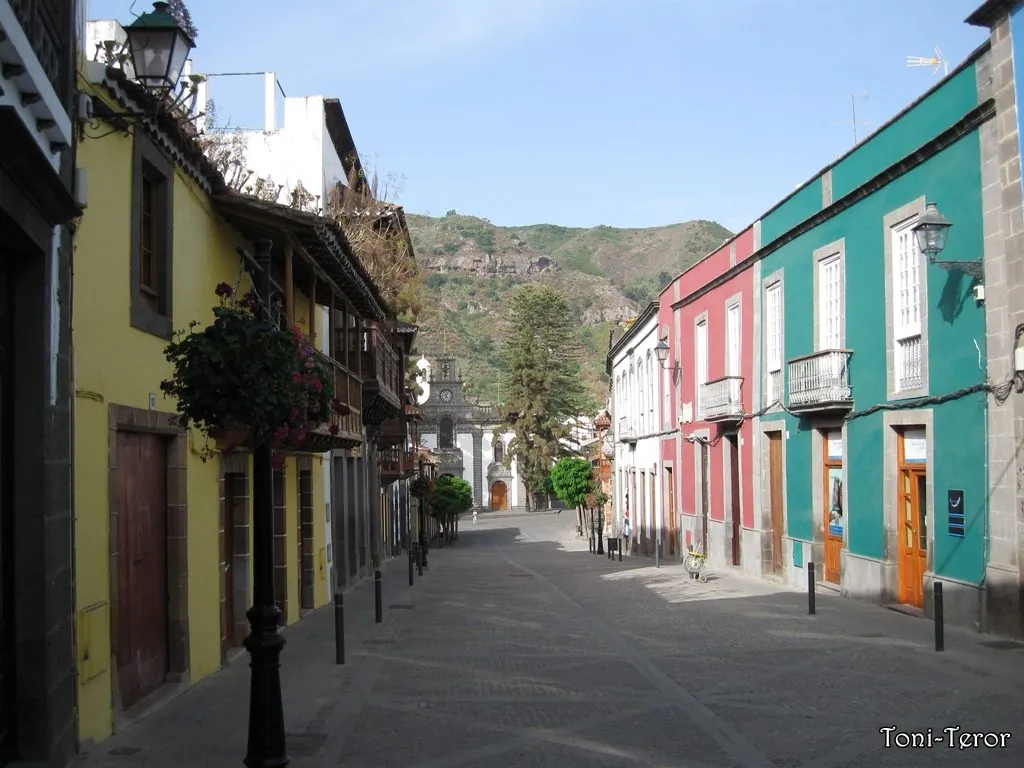
Photo: Toni Teror · CC BY 3.0 · Wikimedia Commons · converted
The key sounds
Three features do most of the work in making Canarian sound the way it does:
- Seseo. Canarians pronounce z and soft c as an "s", not the Castilian "th". So cinco sounds like "sinko" and plaza like "plasa" — exactly as in Latin America, and quite unlike central Spain.
- Ustedes for everything. Canarians don't use the plural vosotros ("you all") that mainland Spain uses among friends. They use ustedes for every "you" plural, formal or casual — again, just like Latin America. You'll never hear a Gomeran say vosotros.
- Aspirated and dropped s. The letter s at the end of a syllable softens to a breathy "h" or vanishes altogether. Las playas becomes something like "lah playah", and los amigos blurs into "loh amigo". It's what gives Canarian its relaxed, flowing, slightly Caribbean lilt.
Add a fondness for the affectionate diminutive — everything becomes -ito or -illo, a momentito here, a cafelito there — and you have the whole warm, unhurried music of island speech.
Don't worry about the dropped s tripping you up. Standard Spanish is understood everywhere, and staff in resorts speak clearly to visitors. The dialect is something to enjoy noticing, not a barrier to overcome.
Words you'll actually hear
The most fun is the vocabulary — a set of words unique to the islands (many borrowed from the Guanches, Portuguese, English or the Americas) that even mainland Spaniards don't always know.
| Canarian word | Mainland Spanish | Meaning |
|---|---|---|
| guagua | autobús | bus |
| papa | patata | potato |
| cotufas | palomitas | popcorn |
| millo | maíz | maize / sweetcorn |
| chacho / chacha | chico / tío | "mate", "hey you" (from muchacho) |
| fajana / fajá | — | flat land formed by a lava flow reaching the sea |
| baifo | cabrito | kid goat (a Guanche word) |
| enyesque | tapa / aperitivo | a nibble to go with a drink |
A few of these are essential for a visitor. Guagua is the single most important — every bus, timetable and stop uses it, so "¿dónde está la guagua?" ("where's the bus?") is far more useful than the textbook autobús. And on any menu, papas means potatoes, as in the island's beloved papas arrugadas. To dig into the food words, see our guide to Canarian food.
The talking-back word: chacho
Chacho (a shortening of muchacho) deserves its own mention. Canarians sprinkle it through conversation the way an Australian uses "mate" or a Londoner "mate" or "man" — as a friendly filler, an exclamation, a way to open a sentence. "¡Chacho, qué calor!" — "Man, it's hot!" You'll hear it constantly, and it's a sure sign you're listening to a local rather than a mainlander.
Politeness and warmth
Beyond the words and sounds, Canarian speech has a distinctive gentleness. Islanders have a reputation across Spain for being especially soft-spoken, courteous and unhurried — the phrase often used is aplatanado, meaning relaxed to the point of being "as mellow as a banana". People take time over greetings, use warm diminutives, and rarely raise their voices. It's a manner that matches the climate: easy, friendly and in no rush.
One small courtesy: because Canarians don't use vosotros, using the polite ustedes for any group is always safe and never sounds stiff here — unlike on the mainland, where it can feel over-formal among friends.
Enjoying the dialect
You don't need to master any of this to have a wonderful holiday — but tuning your ear to it adds a whole extra layer of pleasure. Notice the missing s, the "s" where a "th" should be, the affectionate -ito on every other word, and the little island vocabulary of guaguas, papas and cotufas. Do that, and you'll realise you're not hearing "bad" or "lazy" Spanish at all. You're hearing a living, five-hundred-year-old conversation between the Canaries, Andalusia and the Americas — one of the most charming accents in the whole Spanish-speaking world.