Playa de Los Cristianos is the original town beach of Los Cristianos in southern Tenerife: a sheltered bay of pale golden sand, roughly 345 metres long, tucked between the harbour wall and the old town, with calm water that suits small children and older swimmers. It is smaller, busier and more local in feel than its big neighbour, Playa de las Vistas, and it comes with fishing boats moored off the sand and ferries to La Gomera passing a few hundred metres away. For a swim before breakfast or an hour after lunch in town, it is hard to beat for convenience.
People often treat "the beach at Los Cristianos" as one place. In fact there are two side by side. Playa de las Vistas is the long, wide modern beach that runs west towards Playa de las Américas. Playa de Los Cristianos is the older, shorter bay on the harbour side, where the town began, and it is the one this page covers.
If you are deciding where to stay or what the town offers beyond the sand, our guide to Los Cristianos covers the resort as a whole. Here the focus is the beach: what it is like, how the sea behaves, what changed with its Blue Flag in 2026, and how to use it well.
A harbour beach with fishing boats on the water
The bay curves gently from the foot of the harbour breakwater towards the promenade in front of the old centre. The sand is pale and golden, the beach is about 80 metres deep at its widest, and the slope into the water is gradual. Rows of sunbeds and parasols fill the middle, with open sand left at the edges for towels.
What makes it different from every other beach on this coast is the working harbour. Small fishing boats lie at anchor just off the eastern end, and the sound of outboard motors and gulls is part of the background. Beyond them you see the white bulk of the inter-island ferries sliding in and out of port. It feels like a Spanish town beach that happens to have tourists on it, rather than a resort beach built for them.
The crowd reflects that. In winter you will find long-stay visitors from northern Europe who have been coming for decades, Canarian families at weekends, and holidaymakers from the hotels and apartments on the hill behind. Mornings are the quietest time; by late morning in high season the sunbeds are usually full.
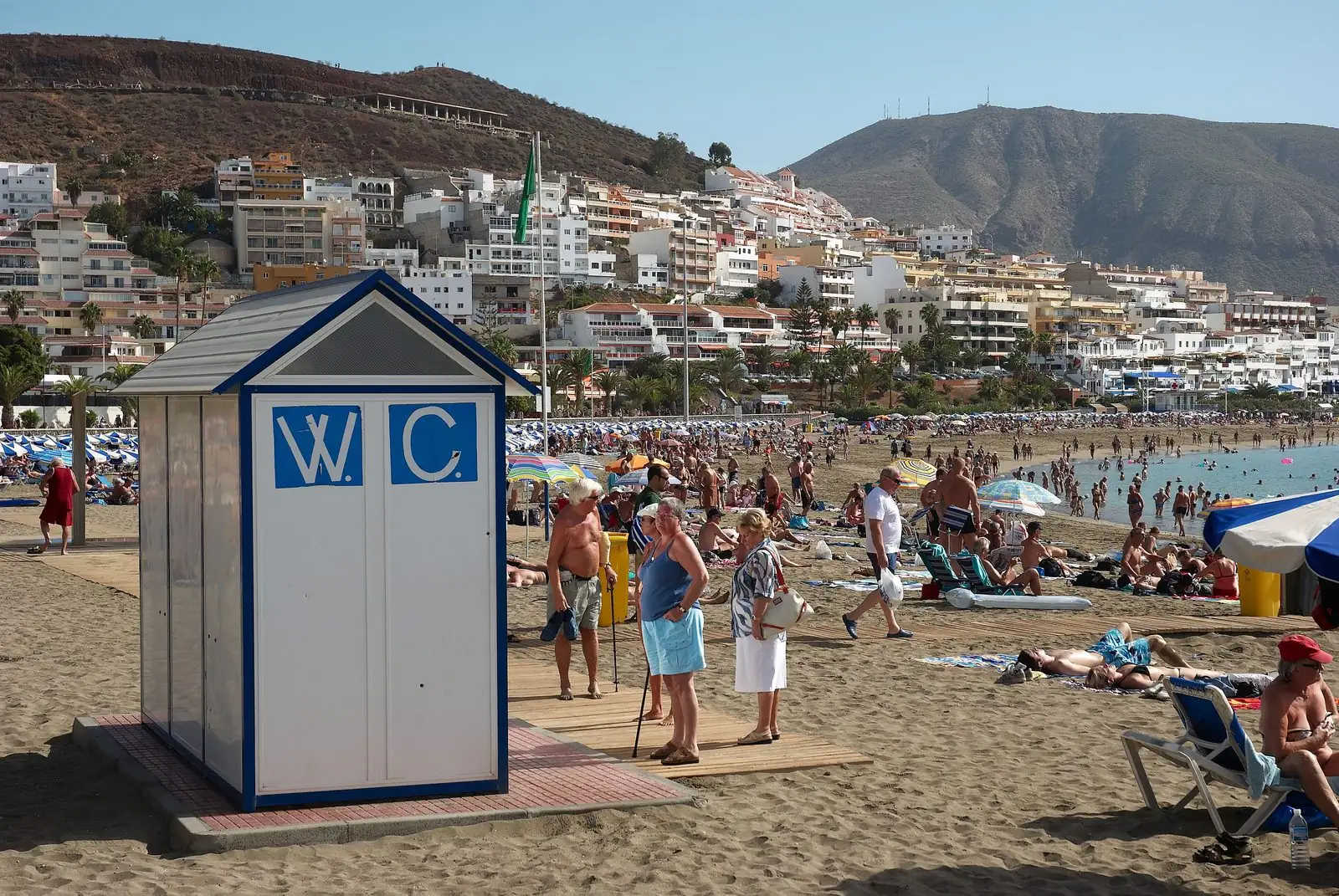
Photo: Wouter Hagens · CC BY-SA 3.0 · Wikimedia Commons · scaled
Calm water in the lee of the port
The harbour breakwater does the work here. It shields the bay from the swell and from much of the wind, so on a typical day the sea is flat or close to it, and the shallow, sandy entry makes it one of the most forgiving places to swim in the south of the island. It is a good beach for children who are still nervous of waves and for anyone who wants to wade in gently.
Calm does not mean empty water. Boats use the area beyond the swimming zone, so stay within the marked bathing area and do not swim out towards the harbour mouth or the anchored boats. Lifeguards cover the beach in the main bathing season; follow their flags and instructions, and on the rare days when a southerly swell reaches this coast, expect a short shore break even here. Our page on beach flags and swimming safety explains what each colour means.
Snorkellers will find more to look at around the rocks at the edges than over the sand in the middle. The harbour is also a base for dive centres, with boats heading out to the reefs along this stretch of coast.
What happened to the Blue Flag
For years Playa de Los Cristianos flew a Blue Flag, and it was the town's flagship beach. In May 2026 it lost the award. According to Canarian Weekly, Adeac, the Spanish body that runs the Blue Flag scheme, said the beach had not achieved an "excellent" water-quality rating in the sampling carried out in 2025, which is one of the scheme's core requirements. It was the only beach in the south of Tenerife entered for 2026 to lose the flag.
Arona council's response is worth reading carefully, because it changes what the loss means for a swimmer. The council said three individual samples had slipped from "excellent" to "good", that quality never fell to "insufficient", that official health controls found the beach suitable for bathing throughout, and that later tests had improved. Local press has long noted that its position right beside the port makes the Blue Flag harder to hold than on an open beach. The council has said it intends to win the flag back.
No flag is not the same as a bathing ban. A beach can lose its Blue Flag over a handful of samples and still be classed as fit for swimming by the health authorities. If the water were ever judged unsafe, the beach would be closed to bathers and signed accordingly, as has happened elsewhere on Tenerife. Our page on Blue Flag beaches explains how the scheme works and why flags come and go.
Sunbeds, showers and access
This is a fully serviced town beach. Sunbeds and parasols are for hire in rows across the centre, and there are showers, footbaths, bins and regular cleaning. Bars, cafés, ice-cream shops and restaurants line the promenade directly behind, so you can come down with a towel and nothing else. Sunbed prices vary by season and by operator; ask before you settle in.
Access is easy. The promenade along the back is flat, and the official Tenerife tourism site lists adapted access for people with disabilities. If you need an assisted-bathing service with amphibious chairs and trained staff, though, the place to go is next door: Playa de las Vistas has one of the best-known accessible bathing points on the island, a few minutes' walk west along the seafront. Our page on the Canaries for older travellers explains why this corner of the south is so popular with people who want everything on the flat.
How Los Cristianos learned to share its beach
Los Cristianos was a fishing village long before it was a resort, and the beach was where boats were hauled out and catches landed. The first pier was built in 1909 and the port was enlarged in 1934 to take bigger vessels. Tourism came later, in the second half of the twentieth century, and the first visitors were mostly from the Nordic countries, above all Sweden, drawn by a climate that doctors considered good for health. The tourism office describes this as one of the first beaches on Tenerife to attract foreign visitors, from the 1960s.
The Swedes left their mark in the street plan. One of the main roads in the town is still called Avenida Suecia, Sweden Avenue, a name that puzzles many British visitors who walk along it on the way to the beach. It is a small reminder that this was a winter-sun town for Scandinavians before package holidays from Britain took off.
The town's patron is the Virgen del Carmen, protector of fishermen, and her fiestas fall around the first Sunday of September. It is the one time of year when the harbour and seafront fill with locals rather than visitors, and the beach sits right in the middle of it.
Ferries, whale trips and the harbour next door
Because the beach shares its bay with the port, it is the natural place to wait for a boat. Ferries leave Los Cristianos for San Sebastián de La Gomera, and services also run on to La Palma and El Hierro; our page on ferries between the islands sets out the routes. A morning on the sand before an afternoon sailing is an easy way to fill a gap.
The harbour is also one of the main departure points for whale and dolphin watching in the channel between Tenerife and La Gomera, where pilot whales live all year. The ticket kiosks and touts on the quay are a few steps from the beach. Choose a licensed operator and a morning trip, when the sea tends to be calmer.
Use the beach as your ferry waiting room. If you are taking a day trip to La Gomera, leave your bag at your hotel, spend the early morning swimming here, and walk the five minutes to the terminal with time to spare. Coming back in the evening, the beach bars are still open for a drink while the light goes.
Las Vistas, El Camisón and the coast either side
Walk west and the promenade leads straight onto Playa de las Vistas, which is longer and wider, with imported sand and a more modern, open feel. Keep going and you reach Playa El Camisón, a small cove between breakwaters at the start of Playa de las Américas. All three are linked by one continuous seafront walk, so you can try each in the same day.
East of the harbour, the town gives way to rockier shore. Playa de los Tarajales is a small beach of dark sand and stones near several hotels, and beyond it, under the bulk of Montaña de Guaza, the rocky cove of El Callao is frequented by naturists; our page on naturism and nudist beaches covers the etiquette. Montaña de Guaza itself is a protected natural monument, and the paths up it give the best view down onto the beach and harbour.
Getting there
If you are staying in Los Cristianos, you will walk. Most of the town lies within fifteen minutes of the sand, though the streets climb steeply inland and the walk back up is harder than the walk down. From Playa de las Américas and Costa Adeje, the seafront promenade is the pleasantest route.
Tenerife South airport is a short drive along the motorway, and our page on Tenerife South airport transfers compares the bus, taxis and Uber, which operates in this part of the south. Los Cristianos has its own bus station, and TITSA buses link it with the rest of the island; see buses in Tenerife for routes and the travel card. Driving in is possible, with car parks near the port, but in high season spaces near the beach fill early.
Small, central and sheltered
Playa de Los Cristianos is not the biggest or the smartest beach in the south of Tenerife, and it does not try to be. Its strengths are position and shelter: calm water behind the harbour wall, a town on its doorstep, and the boats coming and going in front of you. For families with small children, for older visitors and for anyone staying in the old part of Los Cristianos, it is the obvious daily beach.
If you want more space, walk five minutes to Las Vistas. If you want a beach that still feels like the fishing town it grew from, stay here, ignore the missing Blue Flag, and swim in the morning before the sunbeds fill.