At the very southern tip of La Palma, two young volcanoes rise from a landscape of black cinder and green vines — this is where you can walk on lava barely more than half a century old. The Volcanes de Fuencaliente take in the older San Antonio crater and, right beside it, the raw, still-bare cone of Teneguía, born in a dramatic eruption in 1971. Together they make one of the most accessible and geologically thrilling walks in the Canaries, with a visitor centre, marked trails and giddying views down to the sea. It's a highlight of any trip to La Palma, the greenest and most volcanic of the islands.
A land shaped by fire
La Palma is the youngest and most volcanically active of the Canary Islands, and nowhere is that more vivid than at its southern point. This narrow tail of land has grown outward eruption by eruption, and the ground here is a jumble of black ash, twisted lava and scattered cones. The 1971 Teneguía eruption was one of the last on Spanish soil for decades, until the 2021 Tajogaite eruption reshaped the island's southwest. Standing among these craters, with the land still visibly raw, you get a real sense of an island that is still being built.
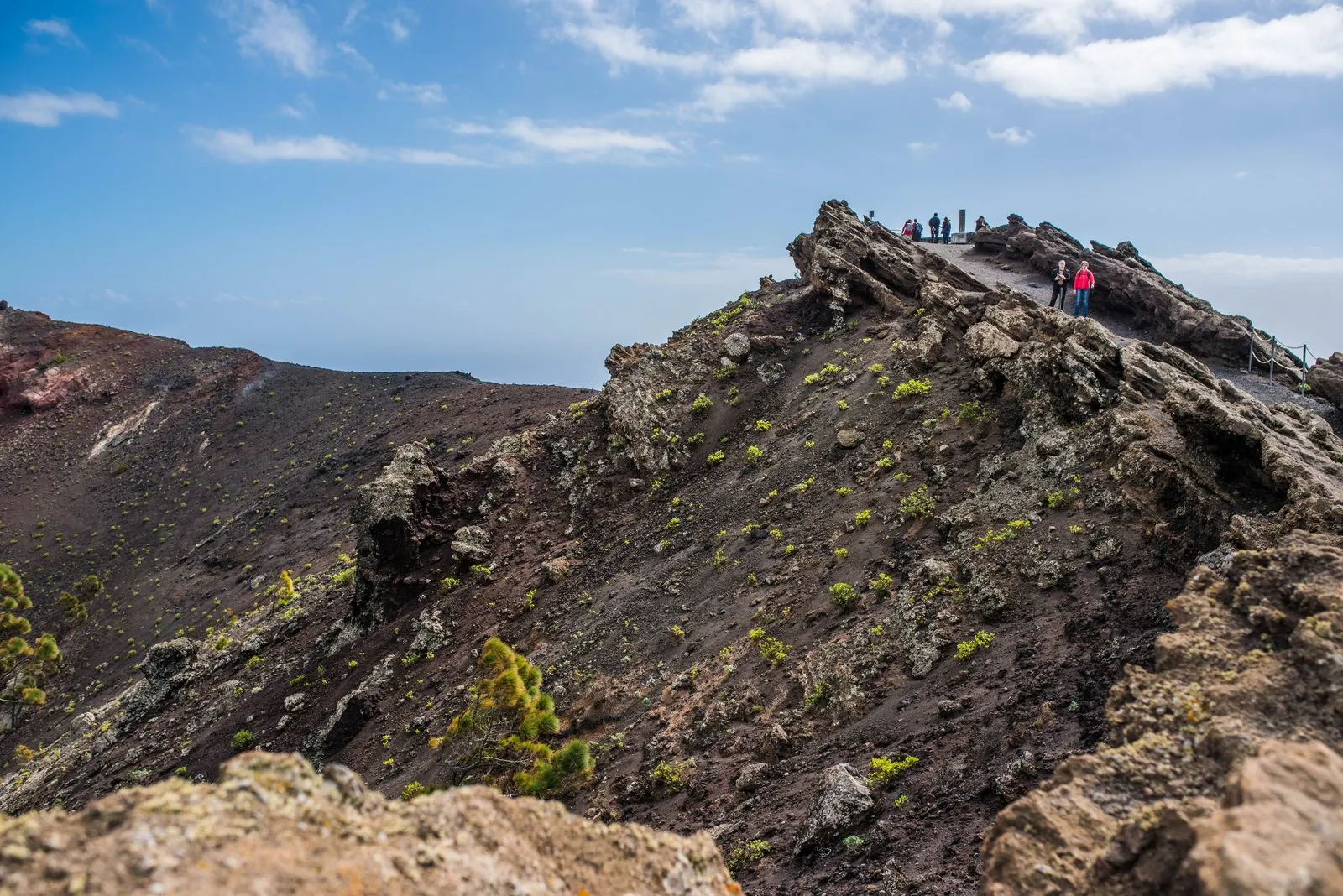
Photo: Bengt Nyman · CC BY 2.0 · Wikimedia Commons · scaled
San Antonio crater and the visitor centre
The starting point for most visits is the Volcán de San Antonio, an older, deep crater with a well-made path running around part of its rim. A visitor and interpretation centre here explains the area's volcanic story and the science of the eruptions, and it's the place to get your bearings before setting out. From the rim path the views are superb: down into the great bowl of the crater on one side, and out over the vineyards, cones and blue Atlantic on the other.
The San Antonio site charges a small entry fee. Access to the crater rim path and its visitor centre is ticketed, with reductions for children — as of 2026 it's a modest amount, but check the current price and opening hours locally before you go. The nearby Teneguía trail itself is free to walk. Wear sturdy shoes for the loose volcanic ground and bring sun protection: there's little shade up here.
Teneguía: walking on 1971 lava
The real showstopper is Teneguía, the younger cone just below San Antonio. A marked trail leads down and across its flanks, and here the lava is astonishingly fresh — dark, sharp, barely weathered rock that erupted within living memory. In places the ground still gives off gentle warmth, a reminder of the heat not far below. The colours are extraordinary: black, red, yellow and rust, streaked with minerals. It's a genuinely otherworldly place to walk, and one of the few spots anywhere you can stand on lava this young.
Combine the crater and the coast. The area is part of a longer walking route that continues all the way down to the sea at the island's black southern point. If you're up for it, carry on past Teneguía towards the coast, where you'll reach the working Salinas de Fuencaliente salt pans and their two lighthouses — a spectacular contrast of white salt, black lava and blue ocean. It's downhill to the sea, so arrange a car or plan your return accordingly.
The vineyards of Fuencaliente
Improbably, this scorched landscape is also wine country. The mineral-rich volcanic soil and warm southern climate make Fuencaliente one of La Palma's prime wine areas, and you'll see vines growing in the black earth right up to the edge of the lava fields. Several bodegas in the area welcome visitors for tastings — a glass of crisp local white with a view of the craters is a fine way to end a morning's walking.
Getting there and practicalities
The volcanoes sit above the village of Fuencaliente (also called Los Canarios) at the southern tip of the island, reached on the main road down the west coast. A hire car is by far the easiest way to visit, and lets you link the craters with the salt pans and a bodega; there's parking at the San Antonio visitor centre. Buses serve Fuencaliente village but not the trailheads directly, so most walkers drive or join an organised excursion.
Allow a couple of hours for the craters and the Teneguía loop, or half a day if you're walking down to the coast. This corner pairs beautifully with the rest of La Palma's outdoor riches — the pine forests and volcanic ridge walks that make up so much of the island's superb hiking, and the wooded highlands further north. For anyone curious about how these islands are made, Fuencaliente is the place it all comes vividly to life, right beneath your boots.
Two craters, a stretch of half-century-old lava and vines in the black soil — Fuencaliente is La Palma's fiery front line, still warm to the touch.