Beneath the vineyards and dragon trees of northern Tenerife lies one of the natural wonders of the volcanic world: the Cueva del Viento, or "Cave of the Wind" — among the longest lava tubes on Earth. Formed by the same forces that built Mount Teide, this vast underground labyrinth near Icod de los Vinos is explored on a guided tour that takes you into the very plumbing of the volcano. It is one of the most unusual and memorable things to do on Tenerife.
What is a lava tube?
The Cueva del Viento is not a cave in the ordinary, water-carved sense — it is a lava tube. When highly fluid lava poured down the slopes of the old Pico Viejo volcano thousands of years ago, the surface cooled and crusted over while the molten rock kept flowing underneath. When the eruption finally drained away, it left behind a hollow tunnel: a frozen snapshot of the volcano's inner workings. The result here is an extraordinary maze on several levels, with a total surveyed length of many kilometres — placing it among the very longest lava tubes anywhere in the world.
Inside, guides point out the tell-tale features of this violent birth: lava stalactites, side galleries, terraces marking old lava levels, and cascades where molten rock once poured from one level to the next. It is a geology lesson you can walk through, and a natural counterpart to the volcanic landscapes you'll see up at Mount Teide itself.
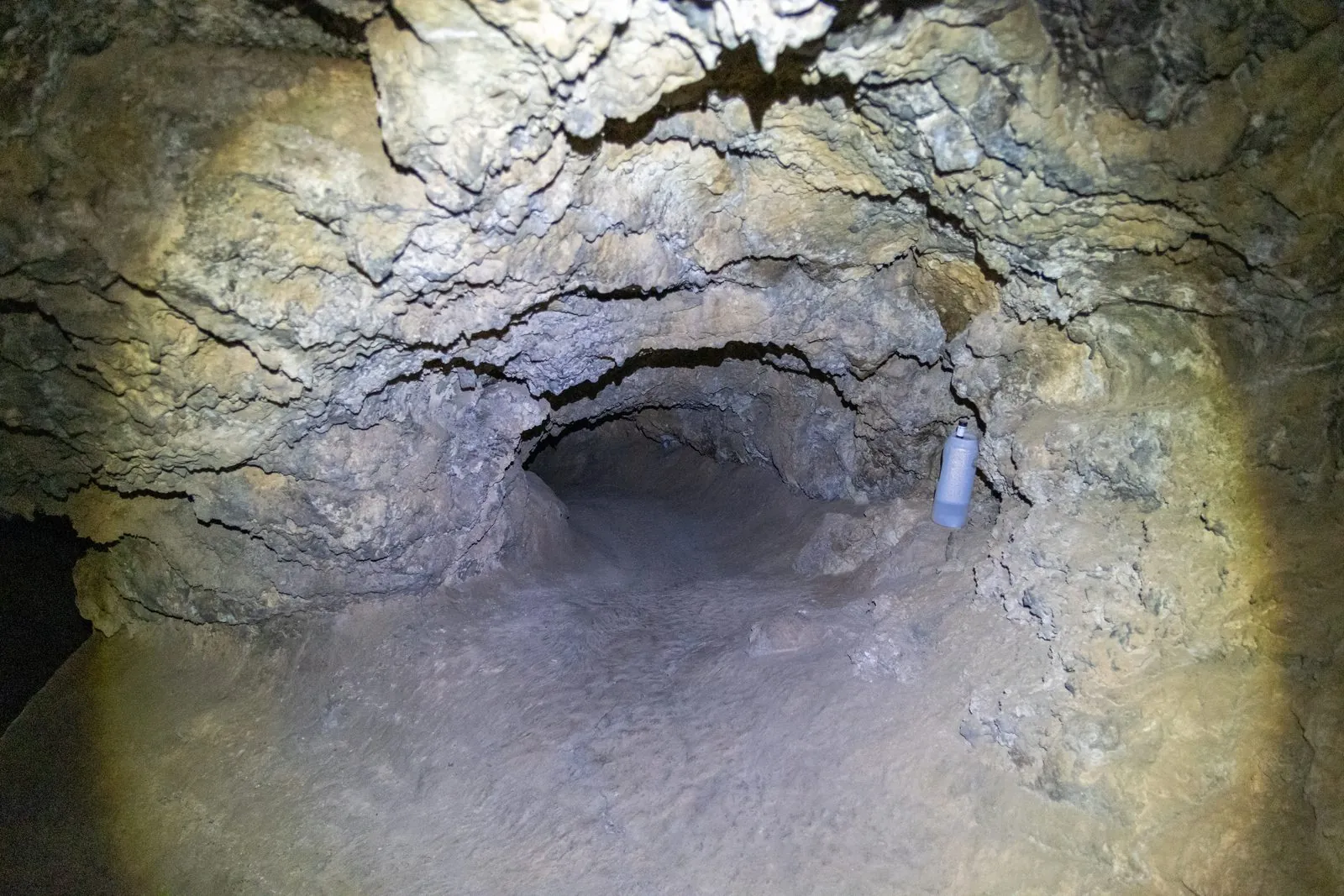
Photo: Mike Peel · CC BY-SA 4.0 · Wikimedia Commons · scaled
A tour into the dark
You cannot simply turn up and wander in — the cave is a protected scientific site, home to rare cave-dwelling creatures, and it is only accessible on an official guided tour. Visits start at the visitor centre in the hills above Icod de los Vinos, where an introduction explains how the tube formed and what lives in it. From there a short transfer and a walk through the countryside bring you to the cave entrance, where you are kitted out with a helmet and headlamp before heading underground with your guide.
Book well ahead and come prepared. Tours run in small groups, sell out quickly and must be reserved in advance through the official site, cuevadelviento.net. You'll need closed, sturdy shoes (no sandals), and the visit involves walking on uneven ground, stooping in low sections and spells of near-total darkness. It is not suitable if you are claustrophobic, have limited mobility, or for very young children. Bring a light layer — it is cool underground even when the coast is warm.
Only a modest, carefully managed section of the network is open to visitors, so the tour is gentle enough for most reasonably able adults and older children, but do read the requirements when you book. Prices are reasonable for a guided experience of this kind; check the official website for current tour times, languages and fees, and reserve your English-language slot early in busy periods.
Life in the darkness
The Cueva del Viento is prized by scientists as much as sightseers. Its lightless galleries shelter a community of specialised invertebrates found nowhere else, some of them blind and colourless, perfectly adapted to a world without sun. The cave has also yielded fossil remains of extinct Canarian animals, including a giant lizard and long-vanished birds. Your guide will explain how this fragile ecosystem survives — and why access is so carefully limited to protect it.
It's the tour, not just the cave. A good part of the experience is the guide's storytelling — the eruptions, the science and the wildlife. Take it slowly, keep your headlamp handy and let your eyes adjust; the shapes in the rock reward a closer look.
Where it is, and what to combine it with
The cave lies in the hills above Icod de los Vinos, one of the most famous towns in the north of the island — home to the celebrated Drago Milenario, a giant dragon tree said to be many centuries old, and to the wineries that give the area its name. The visitor centre is signposted from town; you'll want a hire car to reach it comfortably, as public transport up into the hills is limited.
Because it sits in the lush, historic north-west, the Cueva del Viento pairs beautifully with other highlights nearby. Combine it with a stroll around Icod and its dragon tree, the pretty harbour town of Garachico with its natural lava rock pools, or the mountain village of Masca and its spectacular gorge. Together they make a full and varied day on the greener side of the island.
Helmet on, headlamp lit — a walk through the Cueva del Viento is a walk inside a volcano, along a tunnel carved by fire.
For anyone with a curiosity about how these islands were born, the Cave of the Wind is unmissable — a genuinely different day out from the beaches and one of the standout entries in our list of things to do on Tenerife.