Puerto Rico is a purpose-built sun-trap on Gran Canaria's south-west coast — a resort engineered, quite literally, to catch the maximum amount of sunshine. Tucked into a steep-sided valley (barranco) around a busy marina, it boasts two golden beaches, some of the best boat trips and watersports on the island, and a reputation as a friendly, keenly priced family favourite. It's brighter and more sheltered than almost anywhere else on Gran Canaria — the surrounding hills block the clouds and funnel in the sun.
What it's like
Unlike the historic towns further west, Puerto Rico was created from scratch as a holiday resort, and it shows — in a good way and a slightly less good way. The good: it's compact, sunny and geared entirely around having a relaxed beach holiday, with the marina, beach, shops and restaurants all close together at the bottom of the valley. The catch: the resort climbs the steep hillsides on either side of the barranco in tiers of apartment blocks, so where you stay makes a real difference to how much climbing (or how many lifts and buses) your holiday involves.
It's a cheerful, slightly dated but well-kept resort with a strong family and value-holiday feel, popular with British, Irish and Scandinavian visitors. There's a decent amount going on in the evenings without the full-throttle nightlife of Playa del Inglés.
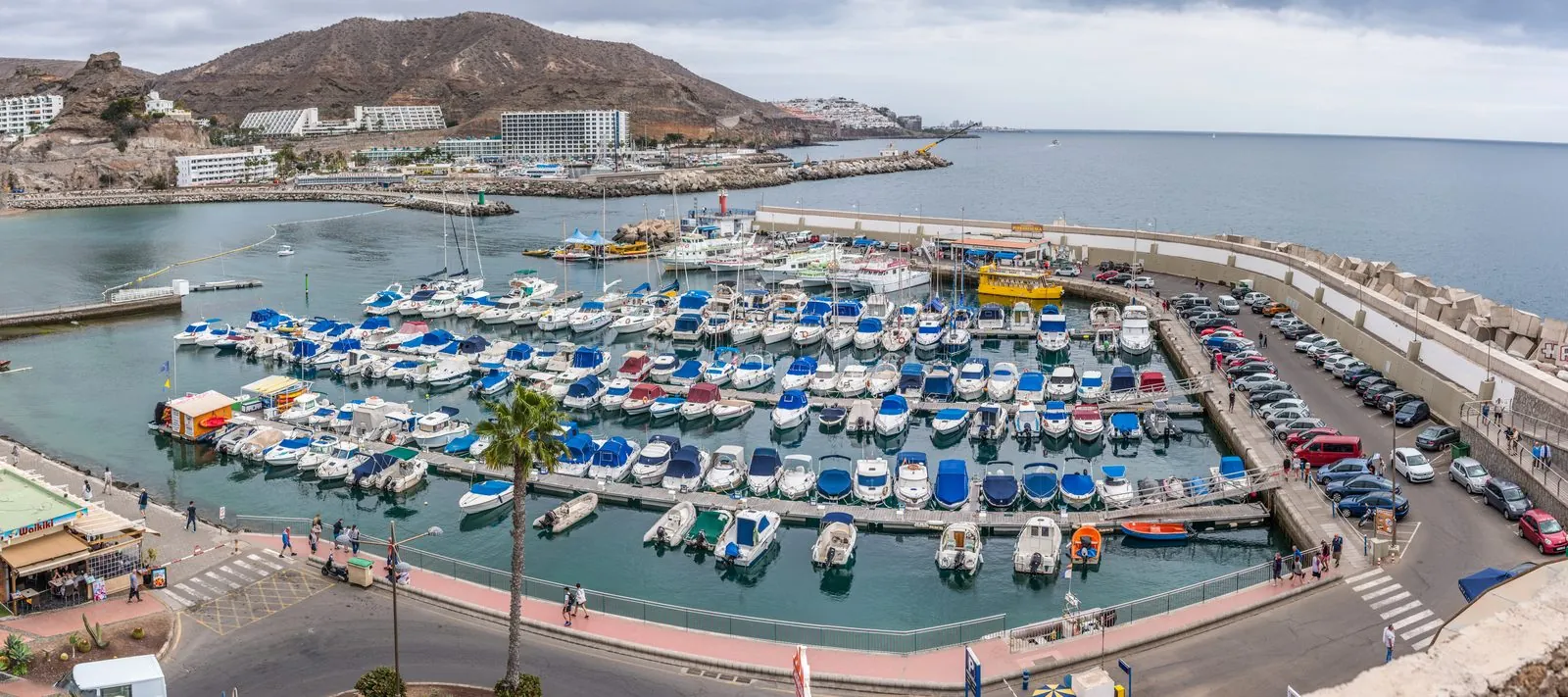
Photo: Bengt Nyman · CC BY 2.0 · Wikimedia Commons · scaled
The two beaches
Puerto Rico's headline feature is that it has two beaches, a short walk apart along a coastal promenade.
Playa de Puerto Rico is the main resort beach — a sheltered, man-made bay of golden sand right beside the marina, with calm water, sun-loungers, and everything you need close at hand. It's ideal for families with young children.
A pleasant seafront walk (or short bus/taxi hop) to the west brings you to Playa de Amadores, a beautiful curved, man-made bay of pale imported sand with exceptionally calm, clear water sheltered behind breakwaters. Amadores is a little smarter and more photogenic, lined with cafés and beach clubs — many visitors split their time between the two.
The coastal promenade linking Puerto Rico and Amadores is lovely, but it's up-and-over with some steps and slopes. If you're carrying beach gear or have limited mobility, the local bus that runs between the two is well worth using.
Boat trips and watersports
Puerto Rico's marina is the launch-pad for much of Gran Canaria's on-the-water fun. This is the island's best base for boat trips — dolphin- and whale-watching excursions, catamaran sailing trips with a swim stop, glass-bottom boats, deep-sea fishing charters and the fast ferry down the coast to Puerto de Mogán. On and around the water you can also try jet-skiing, parasailing, kayaking, paddle-boarding and diving. The consistently calm, sheltered water makes it a reassuring place for first-timers and children.
Where to stay and who it suits
Accommodation is mostly self-catering apartments and aparthotels stacked up the valley sides, plus a smaller number of hotels. Prices are competitive, which is a big part of Puerto Rico's appeal for families and value-conscious travellers.
Because the resort is built on steep slopes, always check where a complex actually sits before booking. "Five minutes from the beach" can mean five minutes downhill — and a stiff climb, or a wait for a lift and shuttle, on the way back. Look for places low in the valley or with reliable lift access if steps are an issue.
Puerto Rico suits families, couples and groups who want guaranteed sun, calm beaches and plenty of daytime activity at a fair price. If you'd prefer more charm and character, neighbouring Puerto de Mogán is the prettier choice; for a more local feel, try Arguineguín just to the east. See our where to stay guide for the full picture.
Eating and evenings
The dining scene is classic resort fare — British and Irish bars, pizza and pasta, grills, Indian and Chinese restaurants — concentrated around the marina, the main shopping centre and the beachfronts. It's reliable, family-friendly and easy on the wallet rather than a gourmet destination, though you can find good fresh fish and some proper Canarian cooking if you look. Read up on what to eat locally before you go. Evenings are relaxed: live music, karaoke, quiz nights and family entertainment rather than clubbing.
Getting there and around
Puerto Rico is about 45–55 minutes by road from Gran Canaria Airport (LPA), depending on traffic — a straightforward run down the GC-1 motorway by taxi, transfer or airport bus. Within the resort, a network of local buses and lifts helps you cope with the hills, and buses connect along the coast to Amadores, Arguineguín, Puerto de Mogán, Maspalomas and Las Palmas. A hire car is useful for exploring inland but not essential for a beach-and-boat-trip holiday — our getting around guide has the details.
Nearby
Just west along the coast lies the island's most charming spot, Puerto de Mogán — reachable by a scenic coastal ferry from the marina, which is a lovely way to arrive. East are the market town of Arguineguín and the big resorts of Maspalomas and Playa del Inglés. For the wider island picture, see our Gran Canaria hub.