Living on Lanzarote is small-island life: you can drive from one end to the other in about an hour, the capital Arrecife is the only real town, and the wind is a constant companion, blowing hardest in summer rather than winter. Most residents live in Arrecife and the towns around it, in the three big resorts of Puerto del Carmen, Costa Teguise and Playa Blanca, or in the white villages of the interior and the north. Each gives a different version of the same island.
The appeal is easy to see: a dry, sunny climate, a striking volcanic landscape protected from the worst excesses of development, and a pace of life that slows right down once the holiday crowds go home. The drawbacks are just as real. Long-term rentals are scarce and expensive, the job market is almost entirely tourism, and specialist services, from some hospital treatments to a wide choice of shops, can mean a trip to another island.
This page is about settling and everyday life. If you are planning a holiday, our page on where to stay in Lanzarote is the one to read. The residency paperwork, from the NIE to health cover, works the same way on every island and is set out in order in our hub on moving to the Canary Islands.
What small-island life really means
Lanzarote is around 60 kilometres long, and almost everything is within forty minutes' drive of Arrecife. That is a blessing on a weekday and a limitation after a few years. Everyone knows someone who knows you, the same faces turn up at the market, the bank and the beach, and news travels faster than the bus.
The island is also more international than its size suggests. An EFE analysis of figures from the Canary Islands statistics institute, ISTAC, published by La Voz de Lanzarote in August 2026, found that foreign nationals made up 24.6 per cent of Lanzarote's population in 2025, about 41,000 people. In the resort municipalities of Yaiza and Tías the share was above a third. The same analysis showed that Arrecife gained 3,838 foreign residents between 2021 and 2025, the second-largest increase of any Canarian municipality after Las Palmas de Gran Canaria. Across the archipelago most of the recent growth has come from Latin America and Italy rather than Britain, and you hear it in the capital's streets.
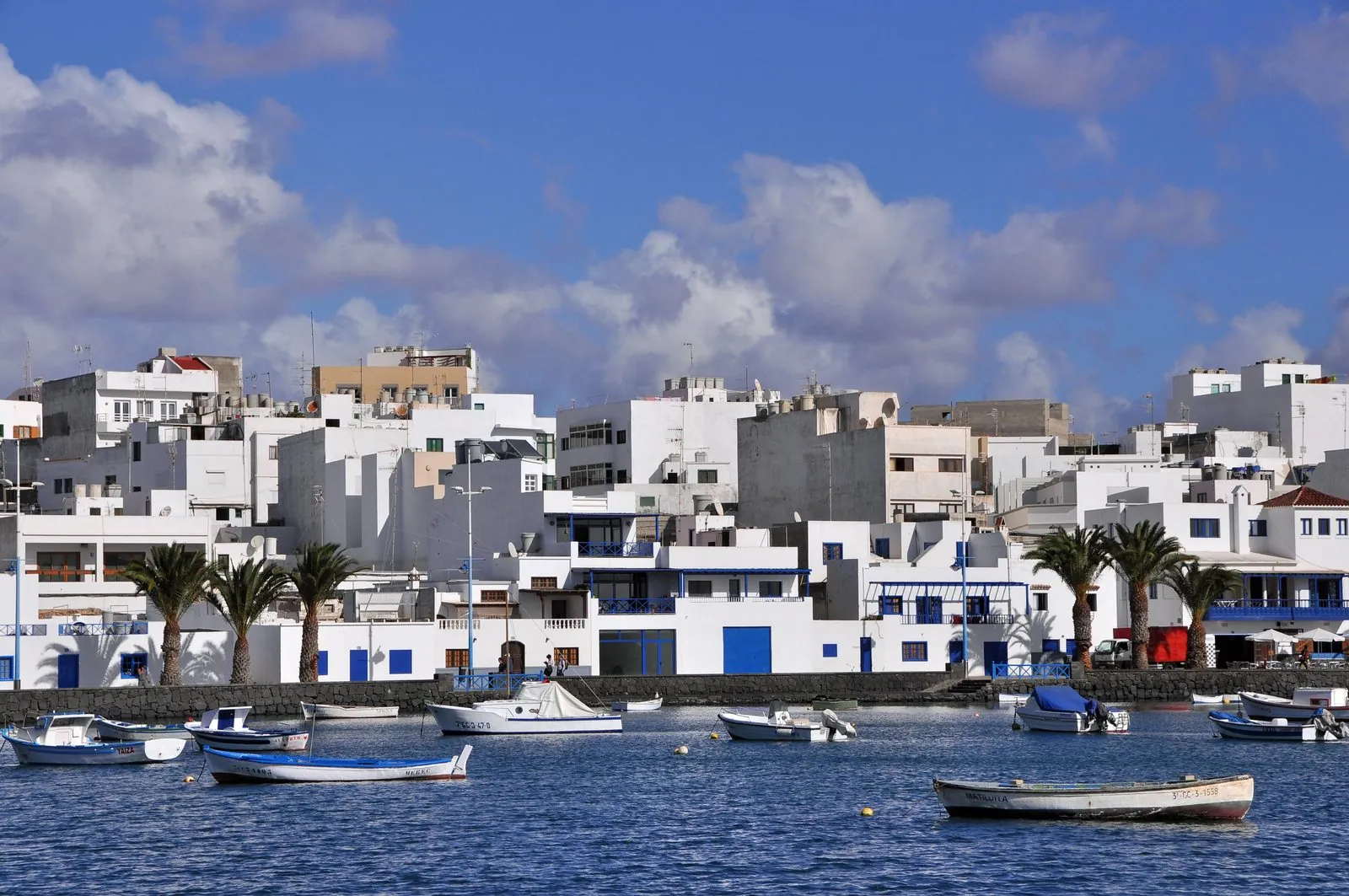
Photo: Marc Ryckaert · CC BY 3.0 · Wikimedia Commons · scaled
Living with the wind
Ask anyone who has lived on Lanzarote what surprised them, and the wind usually comes first. The northeasterly trade winds blow across the island for most of the year, and they are strongest and steadiest in summer, the opposite of what most British newcomers expect. July and August days are hot in the sun but rarely stifling, because the breeze never stops; autumn and winter tend to be a little calmer. Our page on wind in the Canaries explains the pattern across the islands.
The wind shapes daily life in small ways. Washing dries in an hour but needs twice as many pegs. Fine volcanic grit gets into door runners and window tracks, salt crusts the car, and terrace furniture needs to be heavy or tied down. Gardens survive behind walls, and the islanders' answer to the wind is everywhere in the landscape: the semicircular stone walls that shelter each vine in La Geria's wine country, the walled patios of old farmhouses, and houses that turn their backs on the north. When you look at a home, check which way the terrace faces, because the difference between a sheltered south-facing patio and an exposed northern one is the difference between using it and not.
Arrecife and the towns around it
Arrecife is the island's capital and its working town, with the Cabildo, the main shopping streets, the port, the lagoon of El Charco de San Ginés and most of the island's public offices. It is the most Spanish place on Lanzarote, with fewer English speakers and more ordinary life: schools, building sites, bars where the clients are local, and a seafront promenade busy in the evening. Rents are lower here than in the resorts, and the selection of flats is wider.
Around it, the towns of Playa Honda next to the airport, Tahíche and San Bartolomé have grown fast as places for island families and workers to live, with big supermarkets and shopping centres on the edge of town. They are not pretty, but they are practical, and their residents can be at the airport, the hospital or the port in a quarter of an hour.
The resorts as places to live
Puerto del Carmen in Tías, Costa Teguise just north of Arrecife, and Playa Blanca in the far south, in Yaiza, are where most British and Irish residents settle. English is spoken almost everywhere, there are British bars, shops and services, and the sunshine, especially in Playa Blanca, is the most reliable on the island. In winter they are lively; in late spring and autumn they can feel quiet.
They are also the hardest places to find a home. La Voz de Lanzarote, drawing on figures from Spain's housing ministry in a draft of the island's planning document, reported in March 2025 that Lanzarote had the highest rental prices in the Canaries, with Yaiza, Teguise and Tías the dearest municipalities. In February 2026 the same paper counted around 60 homes for rent on one of the main portals, of which 60 per cent were seasonal lets, and most were priced between €1,100 and €1,800 a month. Our page on renting long-term in the Canaries explains the 2026 tenancy rules and how to avoid a seasonal contract dressed up as a permanent one.
The villages of the interior and the north
Lanzarote's villages are some of the most attractive places to live in the Canaries, partly thanks to César Manrique, the artist who persuaded the island in the 1960s and 1970s to keep its buildings low, white and in local style, with no billboards along the roads. The old capital, Teguise, has cobbled streets and the island's biggest Sunday market; Haría in the north sits in a valley of palms and is greener and cooler than the south; and Tinajo, Yaiza village, Femés and Uga each have their own character.
Village life means knowing your neighbours, speaking Spanish and driving to most things. Caleta de Famara on the north-west coast is the exception, a small surf village with a young, international crowd and a famously windy beach. Prices in the villages have risen too: La Voz de Lanzarote reported early in 2026 that asking prices for homes to buy in Haría and San Bartolomé were climbing much faster than in Arrecife, a sign of how many people now want the village version of the island.
Getting around, and getting off the island
A car is all but essential. The island's buses, signed as Arrecife Bus and radiating from the capital's bus station, link Arrecife with the resorts, the airport and the main villages, and our page on buses in Lanzarote sets out what is realistic. Residents have been able to travel free on certain multi-trip passes thanks to state funding; Diario de Avisos reported in October 2026 that this was guaranteed until 31 December 2026 but not yet confirmed for 2027. gov.uk's Living in Spain guidance says a UK driving licence can be used for six months after you become resident and should be exchanged before that period ends.
Leaving the island is part of life too. Ferries from Playa Blanca cross to Corralejo on Fuerteventura, and Arrecife has sailings to Gran Canaria and Tenerife; the airport has direct flights to the UK and Ireland and frequent connections to the other islands and mainland Spain. Registered residents with the right nationality or residence status qualify for a large discount on domestic flights and ferries, so check with the airline or the Spanish transport ministry whether you do once you are on the padrón.
Healthcare on a small island
Public healthcare is provided by the Servicio Canario de la Salud. gov.uk's healthcare guidance for Spain explains that once you are covered, through work, a UK-funded S1 as a state pensioner, or the paid convenio especial after a year on the padrón, you register at your local health centre with your social security number and get a health card. Your GP is at the centro de salud for your address.
The island's public hospital is the Hospital Universitario Doctor José Molina Orosa in Arrecife. It handles emergencies and most routine care, but some specialist treatment is referred to the larger hospitals in Gran Canaria, which means a flight or a ferry for you and anyone coming with you. That is worth weighing seriously if you have a long-term condition. Private clinics in the resorts are widely used by residents with insurance.
Water, work and the cost of an island
Almost all of Lanzarote's drinking water is made from seawater. The island opened what is often described as Spain's first seawater desalination plant in 1964, a story told on our page about water and desalination, and the tap water is safe but can taste faintly salty, so many residents buy bottled water for drinking. Everything else that is not grown or fished locally arrives by ship, and some goods cost more or take longer to arrive than on the bigger islands.
Work is almost all in tourism and the services around it: hotels, restaurants, cleaning, maintenance, car hire, property management. Wages are low by British standards, the seasons matter, and good Spanish opens many more doors. Children usually join the local state school, taught in Spanish; the choice of private international schools is much smaller than on Tenerife or Gran Canaria. For the full picture of what a household spends, our page on the cost of living in the Canaries sets out the numbers.
Is Lanzarote the island for you?
Lanzarote suits people who want sunshine, space and quiet, who find the black-and-white volcanic landscape beautiful rather than bleak, and who are happy to make their own entertainment once the season ends. It suits those who will learn Spanish and drive, and who can live with the wind. It is harder for people who need a big job market, specialist medical care close by or the variety of a city, and for anyone without a secure home lined up before they arrive. Rent for a year, live through a summer of trade winds and a quiet November, and you will know whether this small island is big enough for you.