Behind the sunny beaches, the Canaries are islands steeped in old magic — a place of witches who fly by night, a phantom eighth island that appears and vanishes on the horizon, a fire-demon chained beneath a volcano, and a holy tree that once wept fresh water from its leaves. These legends aren't tourist inventions. Many reach back to the aboriginal Guanches, others grew in the isolation of the barrancos, and some are still half-believed in the villages today. Together they form the archipelago's secret, shadowy side.
Here are the great myths of the islands — the stories locals grew up with, and the real places where you can go looking for them.
The witches of Anaga
Tenerife's wild, forest-cloaked Anaga peninsula is the islands' classic haunt of witches. In the remote hamlets tucked into its ravines — places long cut off from the rest of the island — belief in brujas ran deep. Local lore tells of women who gathered by night at lonely crossroads and mountaintops, who could shape-shift, cast the evil eye, or fly to secret covens. Parents warned children not to wander the misty laurel woods after dark.
The most famous tale is of the witches of Anaga who would supposedly fly across the sea to Cuba and back in a single night, returning before dawn. Whether such stories grew from folk memory of Guanche priestesses, from herbalists and healers feared by the Church, or simply from the eeriness of a fog-bound forest, Anaga keeps its uncanny atmosphere. Walk its ancient trails when the trade-wind cloud pours through the trees and you'll feel exactly why the legends took root here.
Anaga's misty laurel forest is magical in daylight too — one of the oldest woodlands in the Canaries and a UNESCO Biosphere core. Go for the hiking and the atmosphere; the witch stories are a bonus that the fog makes very easy to believe.
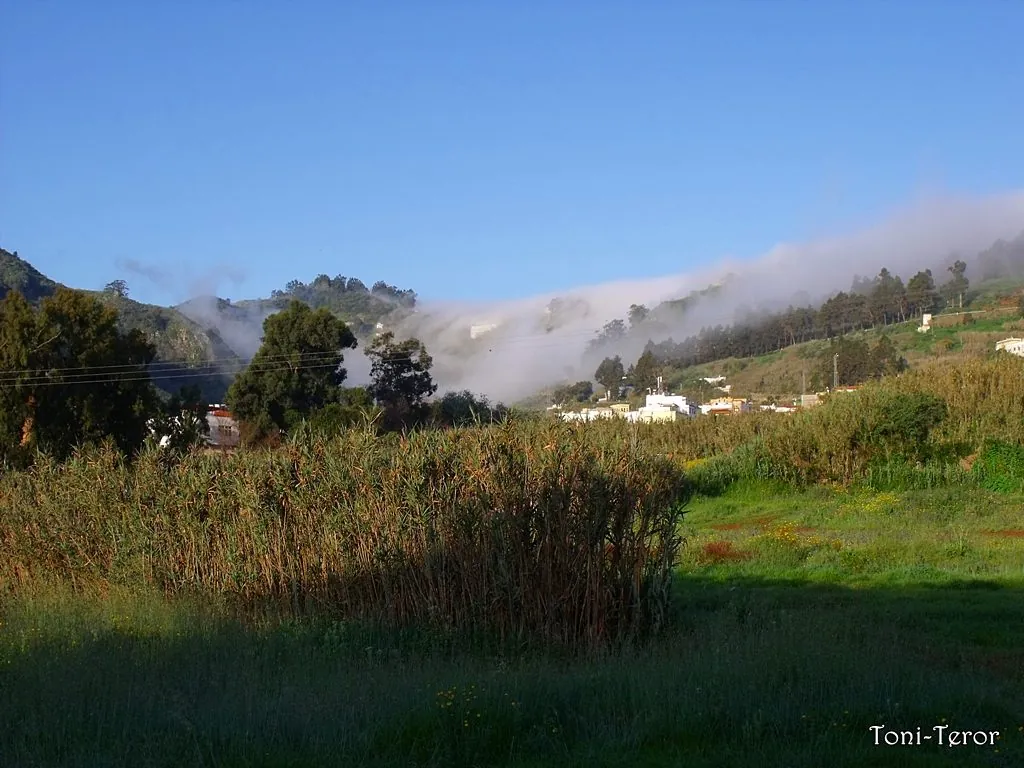
Photo: Toni Teror · CC BY 3.0 · Wikimedia Commons · converted
San Borondón: the phantom eighth island
For centuries, sailors and islanders swore there was another island out to the west — a green, mountainous land that appeared on the horizon at dusk or through the mist, only to vanish before any ship could reach it. They called it San Borondón, and it became the Canaries' great maritime legend: the elusive eighth island that no one could ever land upon.
The name comes from Saint Brendan, the Irish monk-navigator who, legend says, sailed the Atlantic and celebrated Mass on the back of a great whale, mistaking it for an island. Old maps genuinely marked San Borondón west of El Hierro; expeditions set out to find it and always failed. The rational explanation is a mirage — the distant peaks of La Palma or El Hierro lofted and distorted above the sea by atmospheric refraction. But ask an islander, and many will smile and tell you San Borondón is simply shy, and shows itself only to those who aren't looking for it.
Guayota, Echeyde and the taming of Teide
The most powerful of all the myths belongs to the Guanches of Tenerife and their volcano. To them, Mount Teide was Echeyde — "hell" — the abode of Guayota, the demon of fire and darkness. When the mountain rumbled and glowed, it was Guayota at work in his fiery kingdom beneath the peak.
The great myth tells how Guayota kidnapped Magec, the god of light and the sun, and dragged him down into the volcano, plunging the world into cold and darkness. The Guanches begged their supreme god Achamán for help. Achamán descended, fought and defeated Guayota, freed Magec to shine again, and sealed the demon inside Teide forever — plugging the crater with the pale cone of pumice that caps the summit to this day. So when the Guanches saw the mountain's white peak, they saw the stopper on hell itself. It's a myth worth carrying up the cable car — and it connects directly to the wider world of the Guanches.
Teide is an active volcano, closely monitored and currently quiet — but the Guanches weren't wrong to respect it. Treat the national park's altitude, weather and permit rules seriously; the mountain still commands caution, myth or no myth.
The holy Garoé tree of El Hierro
The tiny, remote island of El Hierro has almost no springs or streams, and for its aboriginal Bimbache people that posed a life-or-death problem. Their answer was the Garoé — a great sacred tree whose broad leaves combed moisture from the trade-wind mist and cloud, so that water dripped steadily from its branches into stone cisterns below. The tree, they believed, was a divine gift, and it supplied the island with drinking water conjured from the fog itself.
The Spanish chroniclers recorded the wonder in astonishment, and there's real science behind the miracle: "fog-drip", where vegetation condenses moisture from passing cloud, is a genuine phenomenon still studied today. The original holy tree is said to have been destroyed by a storm centuries ago, but a replacement grows on the spot, and the Garoé remains the enduring symbol of El Hierro — proof that on these islands, myth and nature are often the same story told twice.
Other island spirits
The archipelago brims with lesser legends. There are tales of the Tibicenas — evil black dogs with glowing eyes, servants of Guayota, that prowl the ravines at night. There are drowned bells heard tolling under the sea, cursed treasure, and countless local ghosts tied to particular caves, cliffs and old houses. Every island, and almost every village, keeps its own.
Chasing the legends today
The best of these myths come with a real place attached, which makes them wonderful to build a trip around. Hike the haunted laurel forests of Anaga; ride to the frozen crater of Teide where Guayota sleeps; find the misty ridges of El Hierro where the Garoé still drinks the clouds; and watch the western horizon at sunset for the shy green shadow of San Borondón. You may not meet a witch or spot the eighth island — but you'll come away certain that the Canaries are far stranger, older and more enchanted than any beach brochure lets on.