Playa de Torviscas is a busy, sheltered beach of pale golden sand on the Costa Adeje seafront in southern Tenerife, roughly 290 metres long, sitting between Playa de Fañabé to the north and the Puerto Colón marina to the south. A breakwater keeps the water calm, the promenade runs right along the back, and it is one of only two beaches in Adeje that kept its Blue Flag for 2026. It is a good, easy, family beach with plenty of watersports and boat trips on the doorstep, and it rarely feels quiet.
Costa Adeje's seafront is one continuous walk lined with beaches, and from the promenade it can be hard to tell where one ends and the next begins. Torviscas is the stretch just before the marina, where the hotels give way to the bars and ticket kiosks of Puerto Colón. Its neighbours are Fañabé, the long family beach to the north, and beyond that the smarter Playa del Duque.
This page covers what the beach is like, the sea and the Blue Flag, the watersports and boat trips at the marina end, getting there, and one booking trap that catches out many visitors who think they are staying "in Torviscas". For the resort as a whole, start with our guide to Costa Adeje.
Sand, breakwater and promenade
Torviscas is a compact urban beach, about 290 metres long and around 50 metres deep according to the official Tenerife tourism site. The sand is pale and golden, a world away from the black volcanic beaches of the island's north, and it is groomed regularly. A breakwater shelters the bay, turning what would otherwise be an exposed stretch of coast into a calm, easy place to swim.
Behind the sand runs the Costa Adeje promenade, here lined with restaurants, bars and shops at street level and large apartment and hotel blocks above. It is a lively, sociable strip from mid-morning until late at night. The beach itself is packed with sunbeds and parasols in tidy rows, and in high season the free areas of sand fill up early.
The official tourism listings describe both Torviscas and Fañabé as among the liveliest beach areas in the south of Tenerife, and that matches the experience. This is not a place for solitude. It is a place for a swim, a drink at a beach bar and an afternoon watching the boats come and go.
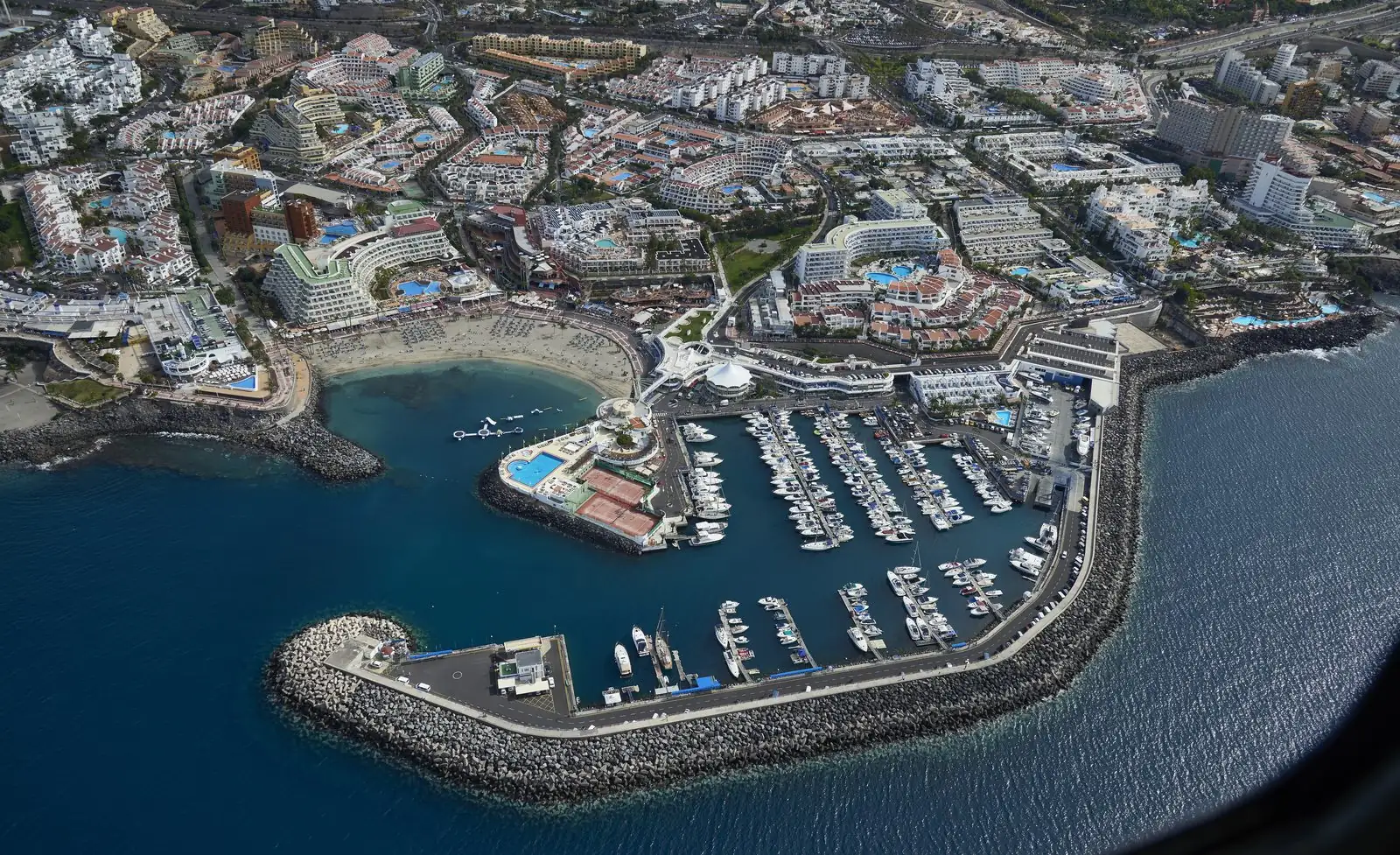
Photo: Wouter Hagens · CC BY-SA 4.0 · Wikimedia Commons · scaled
Calm water and a Blue Flag that stayed
The breakwater means the sea at Torviscas is usually flat or close to it, with a gradual entry over sand. That makes it a comfortable beach for children and for less confident swimmers. As anywhere on the Atlantic, conditions change: a southerly swell or a windy day can bring a shore break, so check the flag before you go in and keep within the marked bathing area. Jet skis and boats operate further out, so do not swim beyond the buoys.
In May 2026, according to Canarian Weekly, Adeje kept its two existing Blue Flags, at Playa del Duque and at Torviscas, and the council said both beaches met all four groups of criteria set by the Foundation for Environmental Education. That makes Torviscas one of the few beaches on this stretch of coast to fly the flag this year. Fañabé, La Enramada and the two beaches at Troya, which held the award in the past, have not had it back since 2021.
The flag tells you about management, not just the sea. A Blue Flag requires excellent water quality, but also safety equipment, information boards, accessibility and environmental management on the beach. Its absence at a neighbouring beach does not mean that beach is dirty. How the award is judged, and why a beach can hold it one year and lose it the next, is set out on our Blue Flag beaches page.
Sunbeds, showers and facilities
Torviscas is a fully equipped town beach. The Tenerife tourism site lists toilets, showers, footbaths, bins, a municipal cleaning service, bars and restaurants, and sunbeds and parasols for hire. Prices for a sunbed and parasol vary with the season and the operator, so ask before you sit down rather than when the attendant comes round.
Access is straightforward. The beach is reached directly from the flat promenade, and the official listing describes adapted access for people with disabilities. Anyone who needs a dedicated assisted-bathing service with amphibious chairs should check with the beach staff on arrival, as these services are seasonal and not every beach has one.
Because the promenade is so close, you do not need to bring much: food, drinks, ice cream and sun cream are all a few steps away. It is worth bringing your own shade if you plan to sit on the free sand rather than hire a sunbed, because there is none on the beach itself.
Watersports at the marina end
The southern end of Torviscas, closest to Puerto Colón, is where the action is. Kiosks on and near the beach rent out watercraft and sell trips: jet ski outings, parascending, banana boats and inflatable rides, kayaks and paddleboards. Operators come and go, and prices change from season to season, so compare a couple of kiosks before you book and ask exactly what is included. Our page on boat trips and watersports explains what each activity involves and what to check about safety and insurance.
If you prefer a quieter swim, head for the northern end of the beach, towards Fañabé. The noise from engines and the stream of people heading to the marina fade quickly as you walk away from Puerto Colón.
Puerto Colón and the boat trips
Torviscas sits right next to Puerto Colón, the main marina in Costa Adeje. Along the quay you will find yachts, fishing charters and the catamarans and sailing boats that run trips along the coast. It is one of the main departure points in the south for whale and dolphin watching, heading out into the channel between Tenerife and La Gomera, where short-finned pilot whales live all year round.
Touts work the promenade around the marina, selling trips with free drinks, swimming stops and guaranteed sightings. Take your time. Look for a boat licensed for cetacean watching (licensed boats fly a blue flag of their own, the Barco Azul), choose a morning departure when the sea is usually calmer, and be wary of anyone who promises that you will swim with dolphins, because approaching the animals closely is not allowed.
"Torviscas" may mean a hill, not the beach. The name covers two areas. Torviscas Playa is the beachfront strip described here; Torviscas Alto is a residential and apartment district on the hillside further up. A booking advertised as "Torviscas" can turn out to be a steep uphill walk from the sea, which matters a lot with small children, a pushchair or in the afternoon heat. Check the exact address and the walking route to the promenade on a map before you book.
Late afternoon and the view to La Gomera
Costa Adeje faces west across the sea, and that changes the beach through the day. In the morning the sun comes from behind the hotels and the sand is soft and cool underfoot; by early afternoon the full glare is on the beach and the water, and the reflected heat off the promenade is considerable in summer. Families with small children often do the morning, retreat for lunch and a rest, and come back after four.
That later session is the best part of the day here. The low sun lights up the water, the boats return to Puerto Colón, and on a clear evening the ridge of La Gomera stands out on the horizon to the west. The beach bars on the promenade fill up for sunset, and the walk north along the seafront is at its most pleasant once the heat goes out of the day.
Getting there and getting around
From most hotels in Costa Adeje and Playa de las Américas, the easiest way to reach Torviscas is on foot along the seafront promenade, which is flat and pleasant at any time of day. From Fañabé it is a few minutes' stroll; from Playa de las Américas it is a walk of around twenty to thirty minutes, past the beaches at Troya and Puerto Colón.
TITSA buses serve the main roads above the seafront, and taxis wait near the marina. Uber also operates in this part of the south, including Adeje; our page on taxis and Uber in the Canary Islands explains how it compares with the local taxis. Tenerife South airport is around half an hour away by road. Driving is possible, but the official listing gives fewer than 50 parking spaces near the beach, and they fill quickly in high season.
A half-day along the seafront
Torviscas works well as the starting point for a stroll north along the coast. Walk past the hotels to Playa de Fañabé, longer and a little calmer, and keep going to Playa del Duque, with its striped changing huts and five-star hotels. The promenade continues towards La Caleta, where the hotels thin out and the restaurants turn to fish. It is an easy, flat walk with drinks and shade along the way.
Heading south instead, the path passes Puerto Colón and the smaller beaches of La Pinta and El Bobo before reaching Playa de Troya in Playa de las Américas. For a break from the sea, Siam Park is a short taxi ride up the hill, and it is a good plan for a windy day when the beach is less inviting.
Lively, sheltered and easy
Playa de Torviscas is the beach for people who want everything close at hand: calm water behind the breakwater, a Blue Flag that survived the 2026 cuts, sunbeds, bars, boat trips and watersports all within a few minutes' walk. It suits families, groups and anyone staying along the Costa Adeje seafront who wants a reliable daily beach.
If you want quiet, walk north to Fañabé or Duque, or head out of the resort strip altogether; our round-up of the best beaches in Tenerife will point you to wilder sand. If you want a lively, easy, well-run beach with the marina at one end, Torviscas does the job well. Just check that "Torviscas" on your booking really means the bottom of the hill.