The barraquito is the Canary Islands in a glass — a small, beautiful, layered coffee of condensed milk, a slug of Licor 43, espresso, frothed milk, a twist of lemon peel and a dusting of cinnamon. Served in a clear glass so you can admire its bands of cream, gold and brown, it's part coffee, part cocktail, part dessert, and utterly Canarian. Order one on a sunny terrace and you've tapped straight into island café culture.
The Canaries take coffee seriously — it's woven into daily life, from the morning cortado to the leisurely after-dinner sipper. And no drink sums that culture up better than the barraquito. Here's what's in it, how to order it, and the other island coffees worth knowing.
What's in a barraquito?
The magic of a barraquito is in the layers, built from bottom to top so they sit in distinct bands rather than mixing. From the base up, you'll typically find:
- Sweetened condensed milk — a thick, sweet base at the bottom of the glass.
- Licor 43 — a golden Spanish vanilla-and-citrus liqueur (Cuarenta y Tres) that gives the drink its signature warmth and perfume.
- A shot of espresso — poured gently so it floats above the sweet layers.
- Steamed, frothed milk — a creamy, foamy cap on top.
- A strip of lemon peel and a sprinkle of cinnamon — the finishing garnish and aroma.
You're meant to admire the stripes first, then stir it all together before drinking — the lemon and cinnamon lifting the sweet, boozy, coffee-rich blend underneath. It's small but indulgent, and it drinks a little like a warm, grown-up dessert. Speaking of which, it makes a lovely partner to a slice of quesillo or a spoonful of bienmesabe from our guide to Canarian desserts.
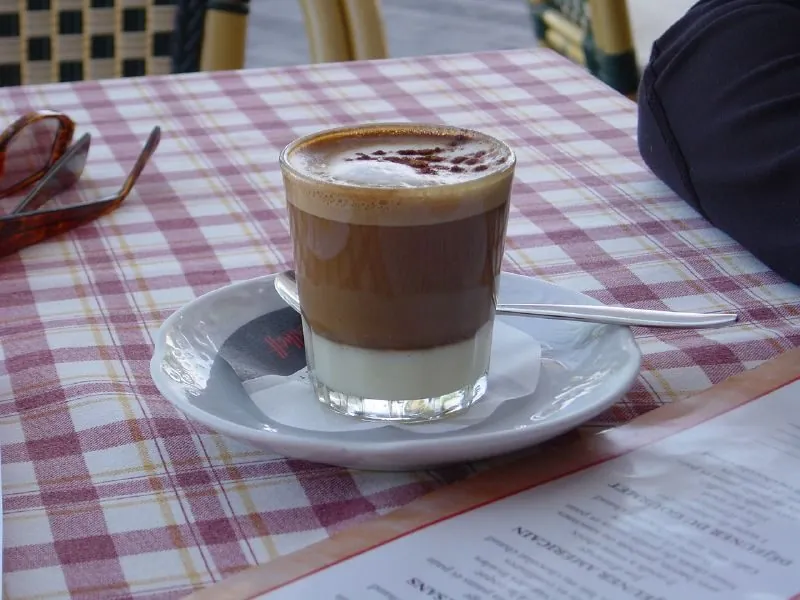
Photo: Juan Manuel Parra · CC BY-SA 2.0 · Wikimedia Commons · converted
How to order one
The key thing to know is the alcohol. A standard barraquito contains Licor 43, so if you'd rather skip the booze — or you're ordering for children — ask for it "sin alcohol" (without alcohol) or "sin licor". Some cafés call the full version a barraquito completo or especial and the plain coffee-and-milk version simply a barraquito, so it's always worth clarifying.
- "Un barraquito, por favor" — the classic layered coffee, usually with the liqueur.
- "Un barraquito sin alcohol" — same drink, hold the Licor 43.
- "¿Lleva alcohol?" — "does it contain alcohol?", handy if you're unsure how a café makes theirs.
Order a barraquito after lunch or dinner rather than first thing — it's sweet and boozy enough to work as a dessert-and-coffee in one. And don't stir until you've admired the layers; that little glass of stripes is half the pleasure.
Cortado leche-leche and the island coffee menu
The barraquito grew out of the everyday Canarian love of the cortado — an espresso "cut" with a little warm milk — and its sweeter local cousins. If you want to sound like a regular, learn these:
| Order | What you get |
|---|---|
| Cortado | Espresso with a dash of milk |
| Cortado leche-leche | Espresso with regular milk and sweet condensed milk — sweet and creamy |
| Cortado condensada | Espresso layered over condensed milk only |
| Café con leche | The larger milky coffee, like a latte |
| Café solo | A straight espresso |
| Barraquito | The full layered coffee with Licor 43, lemon and cinnamon |
The cortado leche-leche ("milk-milk") is the everyday favourite — the barraquito's simpler sibling, minus the liqueur, lemon and cinnamon. If the barraquito feels like too much, this is the one to start your love affair with Canarian coffee.
These coffees are sweeter than you might expect, thanks to the condensed milk — so go easy on adding extra sugar. And remember the standard barraquito is alcoholic; ask before ordering one for anyone who shouldn't have it.
Café culture in the Canaries
Coffee here isn't a takeaway habit rushed on the way to work — it's a reason to sit down. Canarians pause for a mid-morning cortado, meet friends over coffee in the afternoon, and round off meals with a small strong cup, often on a shaded plaza or a sunny terrace. The café is a social hub, and lingering is the point.
The islands even grow their own coffee — the Agaete Valley on Gran Canaria is one of the only places in Europe where coffee is cultivated commercially, on terraces shaded by banana and citrus trees. It's a rare treat to try a locally grown cup at source, and a reminder of how much these subtropical islands can produce.
Where to enjoy it
You'll find a good barraquito almost anywhere Canarians drink coffee — a neighbourhood cafetería, a plaza terrace, a traditional restaurant after a long lunch. Pull up a chair somewhere with a view, order a barraquito (or a cortado leche-leche if you're keeping it gentle), and give yourself twenty unhurried minutes. It's a small, sweet ritual that turns a coffee stop into a genuine taste of the islands. To place it alongside everything else worth eating and drinking here, browse our guide to Canarian food.