Yes, you can use the beach at Anfi del Mar even if you are not staying at the resort: like every beach in Spain it is public, and walking onto the sand and swimming cost nothing. What belongs to the resort is everything behind it: the apartment clubs, their pools, gardens and lifts. You pay only if you want a sunbed, an umbrella or the beach club on the little island. The beach sits on Gran Canaria's south-west coast between Arguineguín and Puerto Rico, in the municipality of Mogán.
Anfi is the beach that ends up on postcards of the island. It is short, about 180 metres according to the Canary Islands tourist board, with pale sand and water that turns a bright turquoise over the sand in the afternoon light. Two breakwaters hold the sea in a calm lagoon, and a heart-shaped artificial island sits at one end. None of it is natural, and that is the point: it was built as the showpiece of a large timeshare development, and it still works as one.
This page explains how access works in practice, what the beach is like to swim from, what costs money, how to get there without paying for a day's parking, and how to deal with the sales side of the resort politely. If you want a natural bay instead, Amadores and Puerto Rico are a few minutes west; if you want a fishing harbour, Arguineguín is a short walk east.
Who owns the sand, and where the line runs
Spain's Coastal Law of 1988 treats the shore, the beach and the sea as public domain. Nobody can own a beach, and no hotel can close one. At Anfi the buildings, the walkways and the breakwaters along the shore are held under concessions from the state coastal authority, Costas, which is why official notices refer to the resort's works rather than to a private beach. One of those notices, published in Spain's official gazette in December 2021, also gives the beach its old official name: Playa de la Verga, after the ravine, the Barranco de la Verga, that reaches the sea here.
In practice the line is easy to see. The sand, the water and the promenade along the front are open to anyone. The four apartment clubs climbing the hillside, with their pools, terraces and private lifts, are for owners and guests. Expect to be stopped if you wander up into the club grounds; nobody can lawfully stop you using the beach itself. If anyone suggests otherwise, a calm "la playa es pública" (the beach is public) is all the argument you need.
Free beach, paid comfort. Spreading a towel on the sand is free. The rows of sunbeds and umbrellas are a rental concession, not resort property, and you can use them whether or not you are staying at Anfi, provided you pay the attendant.
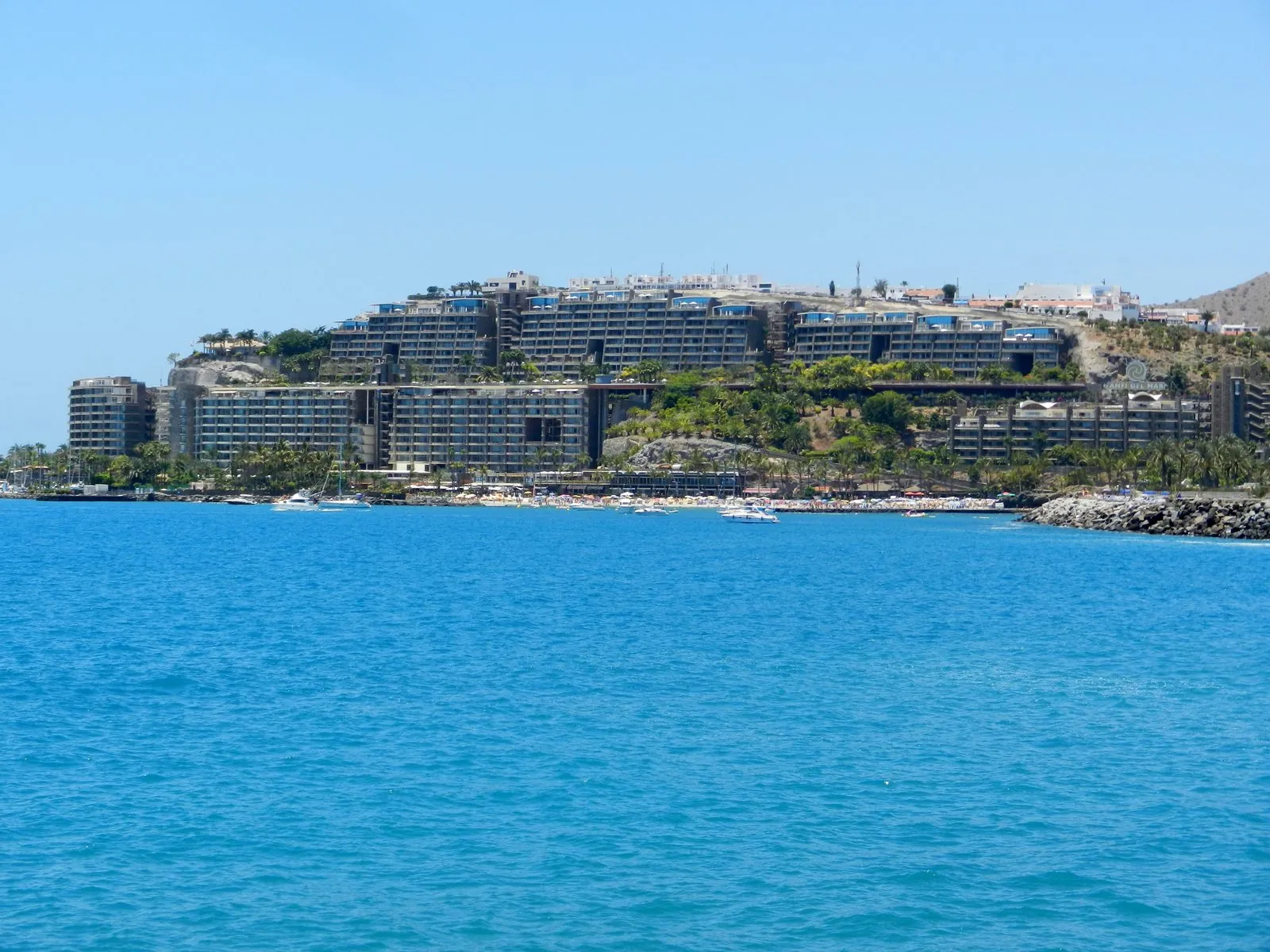
Photo: W. Edlmeier · CC BY-SA 3.0 · Wikimedia Commons · scaled
A beach that was built rather than found
Before the resort, this was a stony cove at the mouth of a dry ravine. The project began in 1988, when the Norwegian businessman Björn Lyng founded the Anfi Group, and the first apartment club opened in 1993. Three more followed over the next ten years. The developers blasted rock to make room for the buildings, built the breakwaters to calm the bay and brought in white sand that is usually described as shipped from the Caribbean. It is lighter in colour than the imported golden sand at Amadores and nothing like the dark volcanic grit of the natural beaches on this coast.
The Scandinavian roots still show: a large share of the owners are Norwegian, and Scandinavian voices are a normal part of the soundtrack on the promenade. The group later added Anfi Tauro, a golf and villa development in the next valley west, which appears in our round-up of golf on the islands.
The heart-shaped island and the marina
The small island at the end of the beach, known as the Isla Corazón or heart island, was built at the same time as the beach. From the sand it simply looks like a palm-planted platform; the heart shape only makes sense from the hillside above or from a boat. It houses the Maroa beach club, with its own loungers, a restaurant and steps that lead straight into deeper water. It is a paid, separately run venue, so treat it like any beach club: check the minimum spend or day-bed price before you settle in.
Beside the island is the resort's small marina, where boat trips, jet-ski hire and small motorboats are on offer, and where the coastal ferry calls. Swimmers should keep to the buoyed area, which is clearly marked; boats come and go just outside it.
Swimming in the lagoon
The breakwaters do their job. On most days the water inside them is close to flat, with a gentle slope from the shoreline and no dangerous currents, which is why families with young children like Anfi so much. At low tide the shallows stretch further out and toddlers can paddle a long way without getting out of their depth. The buoys show how far out you can safely swim, and the water is clear enough over the sand to see small fish around the rocks of the breakwaters.
Calm water is not the same as no risk. The sun on this coast is strong all year, the pale sand reflects it back at you, and a morning on Anfi with no shade is a classic way to burn in winter; our guide to sun safety is worth reading before you go. Check the flag on the day as you would anywhere, using the colours explained in beach flags and swimming safety. The sea temperature follows the rest of the south coast: cool in late winter, warmest in early autumn.
What costs money, and roughly how much
Anfi is not a cheap beach to spend a full day on, but it can be a free one. Prices change and are posted at the rental points, so treat these as a guide:
- Sunbeds and umbrellas: in 2022 visitors reported about €4 each, with a deal for two loungers and an umbrella. Expect that or a little more in 2026.
- Parking: the large public car park at the top of the resort charged about €12 for a full day in 2022. It is the main reason a day here costs more than it looks.
- Toilets: reports differ. Some visitors found coin-operated toilets on the beach, others free toilets in the small shopping centre behind it.
- Food: the shopping centre has cafés, restaurants and a supermarket, so you do not need to carry a picnic down the hill, though plenty of people do.
A couple with two loungers, an umbrella and the car park can spend more on the beach itself than on lunch, which is the strongest argument for arriving by bus or boat.
Arriving without the parking bill
By car, Anfi is on the GC-500 coast road between Arguineguín and Puerto Rico, about five minutes from Puerto Rico and twenty from Playa del Inglés. The public car park sits by the roundabout at the top of the resort, and from there it is a five-minute walk down to the sand. There is informal free parking further away, roughly a quarter of an hour's walk, but it fills early and the walk back is uphill.
The bus is simpler. The stop is called Aguamarina, at the same roundabout as the car park, and several Global routes along the south coast use it, including the coastal line between Puerto Rico and Arguineguín. Frequencies vary by line and by day, so check before you go; our page on Gran Canaria's Global buses explains the network, the cards and the timetables.
The most pleasant way to arrive is by sea. The yellow boats of Líneas Salmón link Arguineguín, Anfi del Mar, Puerto Rico and Puerto de Mogán, and the operator says it runs 48 departures a day along that coast. Fares and times are not published in detail online, so check at the quay. On foot, the seafront walk from Arguineguín past Patalavaca takes about half an hour at a relaxed pace, and it is the cheapest arrival of all.
Come by boat, leave by bus. Take the morning boat from Puerto Rico or Mogán, spend the hot hours on Anfi, then walk up to the Aguamarina stop for the ride home. You see the coast from the sea, skip the car park entirely and never have to climb the hill twice.
The timeshare side of things
Anfi is, first and foremost, a timeshare resort, and selling weeks is its business. Visitors staying elsewhere in the south are sometimes offered a free trip to the resort, a drink or a tour; those offers come with a sales presentation attached. There is nothing illegal about that, and Anfi is generally regarded as one of the more established operators, but it helps to know what you are agreeing to before you step on the bus.
If you only want the beach, you can ignore all of it. Walk down, swim, eat, leave. If you are approached and are curious, our careful guide to timeshare in the Canaries covers cooling-off rights, the resale trap and the questions to ask. If you are thinking of staying at Anfi on a rented week, note that Mogán's small overnight charge has been through the courts; the current position is on our page about tourist tax in the Canary Islands.
Making a day of the coast either side
Anfi sits in the middle of the most built-up stretch of the south-west, which is useful for a day out. East along the promenade is Patalavaca, a darker, plainer beach that is usually quieter, and beyond it the fishing town of Arguineguín, where the Tuesday market and the fish restaurants by the harbour show a less polished side of the coast. West, past the headland, is the big bay of Puerto Rico, and a few minutes further on is Playa de Amadores, the other famous man-made beach, which is longer, more open and has golden rather than white sand.
At the end of the ferry line is Puerto de Mogán, with its harbour, canals and small beach, covered separately on our page about Playa de Mogán. A morning at Anfi and an evening meal in Mogán, joined by the boat, is one of the easiest good days on the coast. For the island as a whole, start with our Gran Canaria overview.
Should you make the trip?
If you want calm, clear, shallow water and the whitest sand on Gran Canaria, yes. Anfi is the island's most photogenic beach for good reason, and young children in particular will be happier here than on the open beaches with waves. It is also small, very popular and built around a sales operation, so it rarely feels peaceful and it never feels wild.
Go early, ideally on the boat, use the sand for free if the sunbed rows are full or the prices put you off, and leave the club grounds to the owners. Treat it as a beautifully engineered swimming lagoon rather than a natural beach, and it delivers exactly what the photographs promise.