Choose Fuerteventura if the beach is the holiday: it has the longest, emptiest stretches of pale sand in the Canaries and a wind that makes it one of Europe's great windsurfing and kitesurfing islands. Choose Tenerife if you want things to do: Spain's highest mountain, two of the best-known attractions in the islands, a historic old town and far more resorts, restaurants and nightlife. Both are warm all year, both are about four hours from the UK, and both keep British time. The difference is in what you do between breakfast and dinner.
The two islands are almost the same size, yet they could hardly be more different. Fuerteventura is long, low and dry, with fewer than 130,000 residents spread over about 1,660 square kilometres, the emptiest of the big islands. Tenerife covers about 2,030 square kilometres, has more than 900,000 people and rises to 3,715 metres at the summit of Teide, with pine forests, laurel woods and a cloudy green north on the way up. On Fuerteventura the horizon is mostly sky; on Tenerife it is mostly mountain.
This comparison goes through the practical basics, the weather, beaches, wind, sights, resorts and how to see both, then gives a verdict for each kind of traveller. If Fuerteventura's beaches are tempting but you also want a city and mountains, our comparison of Gran Canaria and Fuerteventura may be the better match.
The practical basics side by side
| Fuerteventura | Tenerife | |
|---|---|---|
| Typical direct flight from London | About 4 to 4½ hours | About 4 to 4½ hours |
| Airports | One, near Puerto del Rosario | Two: Tenerife South for the resorts, Tenerife North near La Laguna |
| Time zone | UK time all year | UK time all year |
| Driving | On the right | On the right |
| Plugs and currency | European two-pin; euro | European two-pin; euro |
| Highest point | Just over 800 m (Pico de la Zarza) | 3,715 m (Teide) |
| Ride-hailing | None; taxis only | Uber in the south-west only |
| Best for | Beaches, wind, space | Variety, sights, nightlife |
Entry rules are the same on both, as part of Spain and the Schengen area, and our page on passport and entry rules covers what British and Irish visitors need. For safety and local laws, read the UK Foreign, Commonwealth and Development Office's travel advice for Spain, which applies to both islands. Flights to Tenerife are more numerous from more UK and Irish airports, which helps in school holidays and keeps fares competitive; Fuerteventura is well served from the big airports but has fewer regional routes.
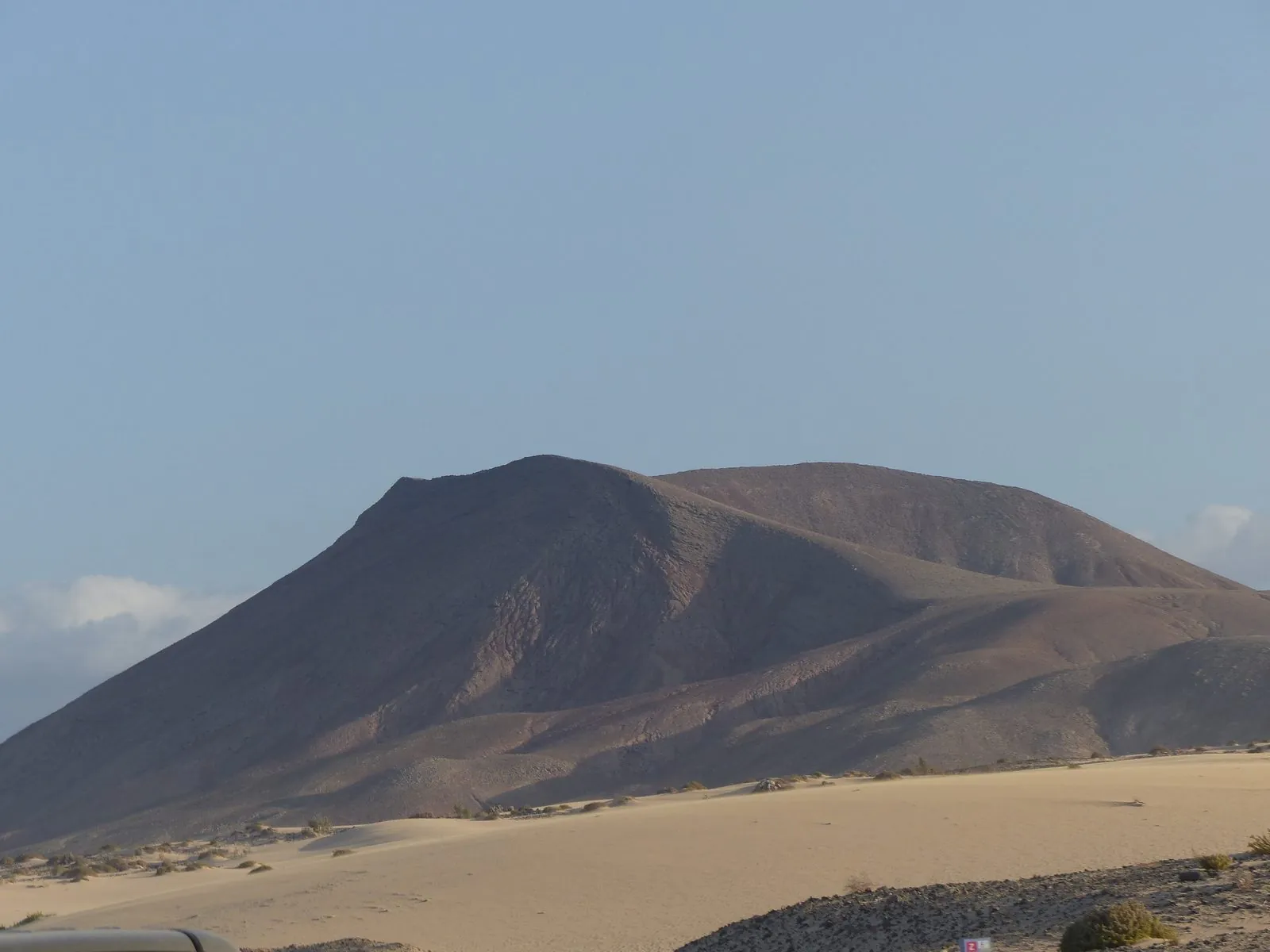
Photo: Benjamín Núñez González · CC BY-SA 4.0 · Wikimedia Commons · scaled
Weather and the surprising cloud count
On paper the two airports have almost the same climate. The figures below are AEMET's 1981–2010 averages for Fuerteventura airport, on the east coast, and Tenerife South airport, which is close to the main southern resorts. They are typical values, not forecasts.
| Month | Fuerteventura airport: day / night | Tenerife South airport: day / night |
|---|---|---|
| January | 21°C / 15°C | 22°C / 15°C |
| April | 23°C / 16°C | 23°C / 16°C |
| July | 27°C / 21°C | 28°C / 20°C |
| August | 28°C / 22°C | 28°C / 21°C |
| October | 26°C / 20°C | 27°C / 20°C |
| December | 22°C / 16°C | 23°C / 17°C |
| Rain, whole year | 98 mm | 132 mm |
| Completely clear days a year | About 69 | About 114 |
The last line is the one most people would not guess. Fuerteventura is drier, yet AEMET counts far more cloudless days at Tenerife South, about 114 a year against about 69. The reason is the shape of the islands. Fuerteventura is too low to stop the trade-wind clouds, so thin streaks of cloud often drift across a sky that is still bright and dry. In southern Tenerife the mountains catch the clouds on the north side, and the resorts in their lee get more completely blue days. Fuerteventura still has about 2,800 hours of sunshine a year by AEMET's count, so this is a question of a few wisps, not grey weather.
Tenerife's catch is that it has several climates. Puerto de la Cruz and the north coast are greener, cloudier and a few degrees cooler in winter, and the high caldera around Teide can be below freezing on a January night while people swim at Los Cristianos. Fuerteventura is more uniform: the weather in Corralejo is much the same as in Morro Jable, 80-odd kilometres to the south.
Beaches: natural sand against built beaches
Fuerteventura's beaches are the main reason people go, and they live up to the pictures. In the north, the Grandes Playas de Corralejo run for several kilometres in front of a protected field of dunes. In the south, Sotavento is a lagoon of sandbars and shallow turquoise water that changes shape with every tide, and Morro Jable has a long, calm resort beach. El Cotillo's small lagoon coves on the north-west coast are among the gentlest swimming spots on the island, while Cofete, under the Jandía mountains, is spectacular, unguarded and dangerous to swim, with strong currents and no lifeguard.
Tenerife is a volcanic island with a steep coast, and most of its natural beaches are small and black. The broad golden beaches in Costa Adeje and Los Cristianos were built or enlarged with imported sand and protected by breakwaters, which is why they are so calm. The most famous of all, Las Teresitas near Santa Cruz, was made in the 1970s with sand shipped from the Sahara. Tenerife's wild beaches, such as Benijo in the Anaga hills or the black sand of El Socorro in the north, are beautiful but often rough.
Fuerteventura's dunes did not blow over from Africa. It is easy to assume that the Corralejo dunes are Saharan sand, but research at the University of Las Palmas de Gran Canaria describes them as bioclastic: mostly crushed shells and the skeletons of marine organisms, with a carbonate content near 90 per cent. Saharan dust only appears as thin layers. The irony is that Tenerife's best-known golden beach really is from the Sahara, because people brought it by ship.
Wind and watersports
Fuerteventura's wind is part of the deal. The north-east trade wind blows most days and is strongest from June to August, when beaches on the east and south coasts can be blasting sand at your ankles by early afternoon. That is exactly why kitesurfers and windsurfers love it: Sotavento has hosted world-tour windsurfing and kitesurfing events in summer for decades, and Corralejo, El Cotillo and Lajares are full of surf schools and board-hire shops. For learners, the shallow lagoon at Sotavento is one of the safest places in Europe to start; our page on windsurfing and kitesurfing in the Canaries compares the spots.
Tenerife has wind too, but in one place. El Médano, next to Tenerife South airport, is the island's windsurfing centre, and the wind there can be relentless. The rest of the south-west coast, from Los Cristianos to Los Gigantes, sits in the shelter of the mountains and is noticeably calmer, which is one reason it suits families who want a still pool day. If wind on the beach would spoil your holiday, Tenerife's south-west is the safer bet; if it would make your holiday, Fuerteventura is.
Sights and day trips
This is where Tenerife pulls far ahead. Teide National Park is among the most visited national parks in Europe, with a cable car to near the summit and miles of walking across lava and pumice. Walking the final path to the very top now needs a permit, and since 19 January 2026 non-residents pay a fee for it, separately from the cable car; our page on the Teide summit permit explains how to book. Then there is Siam Park and Loro Parque, the Masca valley, the laurel forests of Anaga, the colonial old town of La Laguna, which is a UNESCO World Heritage Site, and whale and dolphin watching from the south-west coast, where pilot whales live year-round. You could spend a fortnight on Tenerife and not repeat a day.
Fuerteventura's sights are fewer and quieter. Betancuria, the island's first capital, is a pretty village in a valley in the hills. The caves at Ajuy show some of the oldest rock in the archipelago, the windmills of the interior recall a farming past, and the volcanic cone of Calderón Hondo is a short walk near Lajares. The best day out is the crossing from Corralejo to Isla de Lobos, a tiny protected island with a beach and a walk around a crater; you need a free permit, issued online through the Cabildo's LobosPass, and a boat ticket does not necessarily include it, so check with the operator or apply yourself. After two or three days of sightseeing on Fuerteventura you are back on the beach, which is the point.
Resorts and atmosphere
Fuerteventura's resorts are spread far apart, and choosing one shapes your trip. Corralejo in the north is the liveliest, with a small old harbour, plenty of bars and the dunes on its doorstep. Caleta de Fuste, ten minutes from the airport, is a compact family resort with a sheltered bay. Costa Calma and Morro Jable in the far south sit beside the best of the Jandía beaches but are an hour or more from the airport, and their evenings are largely hotel-based. Nightlife across the island is low-key.
Tenerife's south-west is one large, continuous resort zone. Playa de las Américas is the loud one, with the island's biggest concentration of bars and clubs; Costa Adeje is polished and upmarket; Los Cristianos is an old fishing town turned family resort; and Los Gigantes sits under sheer cliffs further up the coast. In the north, Puerto de la Cruz is the original resort of the 19th-century British visitors and feels like a Spanish town rather than a purpose-built strip. The Tenerife island guide goes through each area in more detail.
Getting around, and doing both
On Fuerteventura a hire car is close to essential. The island is long, the buses connect the main towns but run infrequently to the beaches, and many of the best stretches of sand are reached by dirt tracks that most hire-car insurance does not cover, so read the small print before driving to Cofete. On Tenerife you can do a lot by TITSA bus, the tram runs between Santa Cruz and La Laguna, and Uber works in the south-west, including Tenerife South airport; the rules are on our page about taxis and Uber. A car is still the way to see Teide, Masca and Anaga at your own pace.
Combining the two is easy by air and awkward by sea. Binter flies between Fuerteventura and Tenerife North in about an hour, and our guide to flying between the islands explains how to book a separate inter-island ticket safely. Fred. Olsen Express lists a Fuerteventura–Tenerife sea connection of around three hours twenty minutes (check whether your sailing involves a change); it suits travellers with a car, but for most people a week on each island with one short flight in between is the more sensible plan.
Pick the airport before the flight. If you combine the islands, the inter-island flights usually use Tenerife North, while your UK flight home will probably leave from Tenerife South, about an hour's drive away. Book the second half of the trip in the south and you can drop the hire car at the right airport.
Who should pick which
- Beach lovers who want space: Fuerteventura, easily. Even in February you can walk for an hour on its beaches without meeting a crowd.
- Kitesurfers, windsurfers and surfers: Fuerteventura, with Sotavento for learners and the north coast for waves.
- Families with young children: both work. Fuerteventura for sand and lagoons, Tenerife for the calm man-made beaches, water parks and zoos.
- Walkers: Tenerife, which has mountain, forest and coastal routes at every level; Fuerteventura's walks are mostly short and exposed.
- Nightlife: Tenerife, which has Las Américas and the bars of Santa Cruz.
- Couples who want to switch off: Fuerteventura, ideally in Corralejo or El Cotillo.
- A first visit with lots of sightseeing: Tenerife.
Space or spectacle: the answer
If you picture your holiday as long walks on empty sand, a sunbed with nothing on the horizon and a breeze that never quite drops, book Fuerteventura; our Fuerteventura island guide will help you pick the right end of the island. If you picture yourself above the clouds on Teide in the morning and in an old-town bar in La Laguna at night, book Tenerife. If Tenerife wins but you are torn between it and Lanzarote's calmer landscapes, the comparison of Tenerife and Lanzarote is the next step.